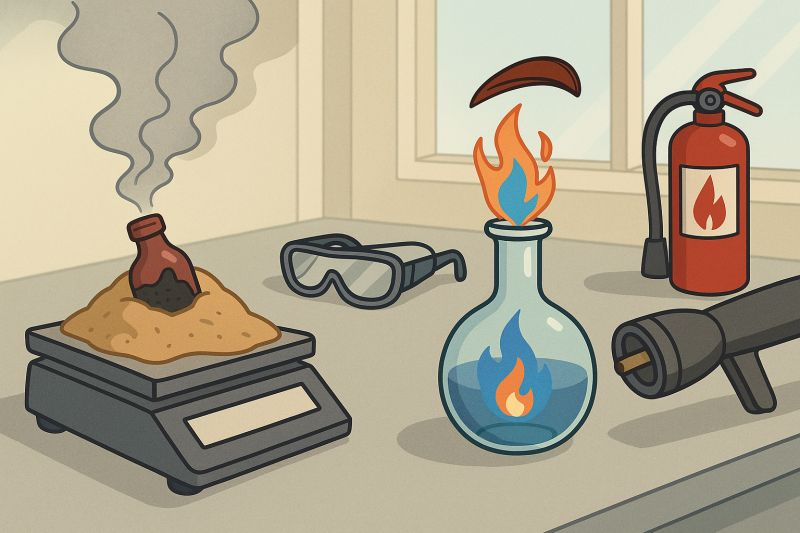
Disasters do not need to be your fault to become your problem.
This one was not mine, thankfully.
Strictly speaking, these were not even my incidents—although the second one sits uncomfortably close to territory in which I could not claim perfect innocence. Both stories fall into the category of things somebody else did first, thereby sparing me the honour.
The Bottle That Bit Back
Long ago, in a laboratory only a couple of postcodes away, someone set about weighing sodium hydride from a plastic bottle.
Yes: plastic.
For sodium hydride, the rest of the story rather writes itself. A little residual moisture, a little heat, and then the whole arrangement made it clear that it disapproved of the plan.
It caught fire.
Panic followed promptly. In the ensuing scramble, the balance ended up buried beneath a distinctly heroic quantity of sand.
In calmer retrospect, a fire blanket might have been neater, and a full extinguisher may have been a touch theatrical for a gram or so of sodium hydride and a quantity of softening plastic. But when something is burning on the bench, tidiness is rarely the first priority.
- Pyrophorics and plastic containers do not make a good partnership.
- Containment and quenching materials should be close at hand before the bottle is opened.
- Sand works, though other dedicated measures may be cleaner and easier to manage.
- Preparation generally performs better than instinctive improvisation.
Flash Dry, Flash Fry
The second episode was not mine either—this time. But I would be lying if I claimed not to understand how it happened.
Picture a freshly rinsed large-flanged flask, still beautifully decorated inside with acetone vapour. Add a chemist in a hurry and a hot air gun.
The result was immediate.
Fwoomp.
A brief blue flame, a startled yelp and at least one eyebrow made a rapid and involuntary exit.
No serious injury followed—only singed pride, a red face, and perhaps the fastest anyone has ever consulted the flammability section of the acetone safety data sheet.
The point is straightforward enough: solvent vapours linger inside narrow-neck glassware more stubbornly than one might like to believe. A hot air gun may feel more civilised than a naked flame, but it can still provide more than enough ignition energy if flammable vapour is trapped in the wrong place.
- Let rinsed glassware air-dry fully before trying to hurry matters.
- Vent flasks upside down so vapours can clear properly.
- Use hot air guns cautiously and well away from flammable solvent vapours.
- If speed genuinely matters, a dry nitrogen or compressed-air line is often a safer choice.
- Your eyebrows are poor sacrificial indicators and do not regenerate on schedule.
Common lessons
- Hazardous materials rarely become safer simply because the task feels routine.
- The right containment tool, ready before you start, is worth far more than a quick improvisation after ignition.
- Vapours, residues and container choice matter just as much as the reagent itself.
- If you find yourself thinking “this will only take a second,” that is often the moment to slow down.
Epilogue
Near misses do not need to belong to you personally in order to be worth learning from.
If you can see a poor setup taking shape—a plastic bottle where there should not be one, a wet flask about to meet a heat source, a pyrophoric handled with optimism rather than planning—say something. It is better to be the mildly annoying voice of caution than the person later allocated the sand bucket.