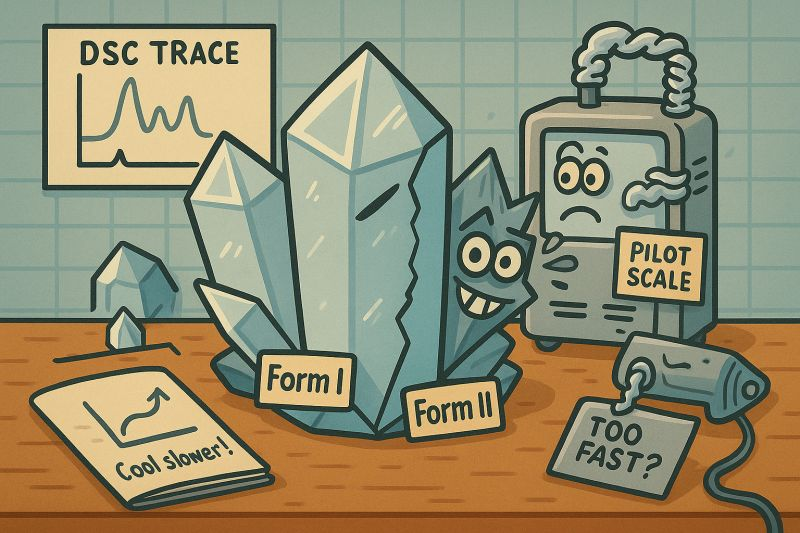
Polymorphism: because one crystal structure is never enough.
We thought we had it.
The active pharmaceutical ingredient was clean. Its melting point was sharp—about 150 °C—and material for toxicology work was ready. It was the sort of batch you begin to trust, not because every possible question has been answered, but because it has behaved well enough that you stop asking quite so many.
Then came scale-up.
The route was the same. The yield was the same. The compound appeared to be the same. Yet somewhere between the small-scale work and the pilot batch, something had shifted.
It was not dramatic. The new material was simply less soluble and less cooperative in the proposed dosing vehicles. A quiet reluctance to behave as its smaller-scale predecessor had behaved.
That is usually a good reason to become suspicious.
Two peaks, one unwelcome answer
Differential scanning calorimetry gave the first clear indication that this was not merely a minor variation in handling.
A single thermal event at roughly 150 °C.
Two reproducible melting peaks—and therefore two forms.
We had not simply made the compound. We had made two versions of it: a polymorphic mixture with different physical behaviour.
The difference was hidden in the notebooks
The chemistry itself had not changed, so attention turned to the process details that are easy to dismiss because they are not things you can weigh into a flask.
The answer was cooling.
The pilot-scale batch had cooled faster than the earlier trial. Not by an apparently dramatic amount, but by enough to push crystallisation down a different pathway and allow a second polymorph to form without any visible warning.
As the Ostwald step rule suggests, a system need not proceed directly to its most stable crystal form. A less stable form may appear first—and, if the process gives it the opportunity, remain part of the isolated material.
No colour change announced the difference. There was no striking change in yield or appearance. The molecules were the same; their internal arrangement was not.
Fixing the process
The answer required no new chemistry and no particularly clever intervention. It required control—and patience.
Cooling was slowed substantially, dilution was handled more carefully, and the temptation to hurry crystallisation was ignored. Across successive runs, the cooling profile was refined until the process reproducibly produced the desired form, with a consistent melting point and predictable solubility.
Toxicology work resumed. Crisis averted.
When a rogue form becomes much more serious
Ritonavir is the example that inevitably surfaces in discussions of pharmaceutical polymorphism.
A new, more thermodynamically stable form—Form II—appeared after the original form had already been used in development. Once present, it readily seeded subsequent crystallisations and made the earlier form extremely difficult to reproduce. Manufacturing was interrupted and substantial process, facility and regulatory work followed.
The scale was very different from this bench tale, but the underlying warning was the same: a small change in crystallisation behaviour can have consequences far beyond the crystallising vessel.
Lessons learned
- A sharp melting point does not, by itself, guarantee a single crystal form.
- Scale changes crystallisation in subtle and frequently unhelpful ways.
- Cooling profiles are part of the process—not an afterthought.
- DSC early is preferable to DSC in a panic.
- The freezer is not your process engineer.
- Detailed laboratory notes may save a later batch.
- Never underestimate the influence of a rogue crystal.
Sometimes the compound is not wrong.
It is just not the form you thought you had made.
References
- Van Santen, R. A. “The Ostwald Step Rule.” Journal of Physical Chemistry 1984, 88(24), 5768–5769. DOI: 10.1021/j150668a002.
- Chemburkar, S. R. et al. “Dealing with the Impact of Ritonavir Polymorphs on Drug Development.” Organic Process Research & Development 2000, 4, 413–417. DOI: 10.1021/op000023y.