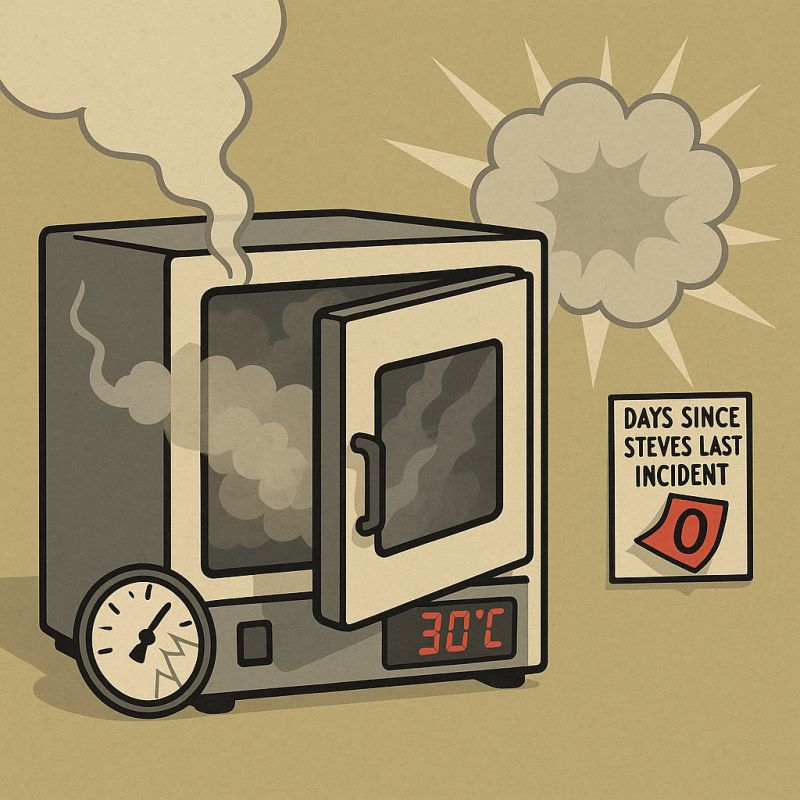
No alarms. No warning. Just a one-way trip to thermal Mordor.
It was all going very well.
The reaction had gone smoothly. The work-up had remained stubbornly civilised. The product was beautifully pure and ready for what should have been a completely uneventful final step: a low-temperature, low-pressure dry in the vacuum oven.
No mystery. No magic. Just routine.
Or so I thought.
The material went into the oven overnight. The next morning I came in expecting to retrieve a dry sample and move on with life.
Instead, I found carbonised wreckage.
From gentle drying to thermal runaway
The oven had failed—not subtly, not gradually, and certainly not in a way that left much room for negotiation. It had run away thermally into the 200 °C-plus region.
Instead of a gentle dry, the sample received an unsolicited audition for spontaneous combustion. The solvent was long gone, and so was the compound.
What remained
- A blackened crust where the product used to be.
- A very deformed bottle.
- Possibly a small family of buckyballs huddled in the ashes.
There had been no warning and no useful intervention available by the time I arrived. The event was already over; only the evidence remained.
The lucky part
This is where fortune decided, for once, to be helpful.
I had loaded only part of the batch—just the amount needed for the next stage. The rest had been left safely aside, untouched by the wrath of the failing hardware.
Better still, the batch had been unusually generous. The literature yield had not merely been matched; it had effectively been doubled. On this occasion, that slight overachievement turned out to be the thing that saved the day.
For once, having extra material was not just pleasing. It was strategically bacon-preserving.
Lessons from a vaporised victory
- Never fully trust an unattended oven—especially overnight.
- Vacuum ovens can fail without the courtesy of a warning.
- Check for temperature alarms, overrides or other failsafes before relying on routine drying.
- When possible, dry only what is needed and keep a reserve of material in hand.
- Carbon has many allotropes, but none of them are your target compound.
Bonus bench tip
If an oven is programmable, check whether it has a genuine high-temperature cutoff, watchdog timer or independent over-temperature protection. If it does not, an external safety relay—or at the very least an additional sacrificial thermometer—may be a very wise investment.
Chemists spend a great deal of time solving complex problems. Occasionally, the laboratory responds by attempting to host an unexpected bonfire.
The main consolation here was that the entire batch had not gone into the oven. The oven still won the skirmish, but it did not win the war.
← Back to all tales