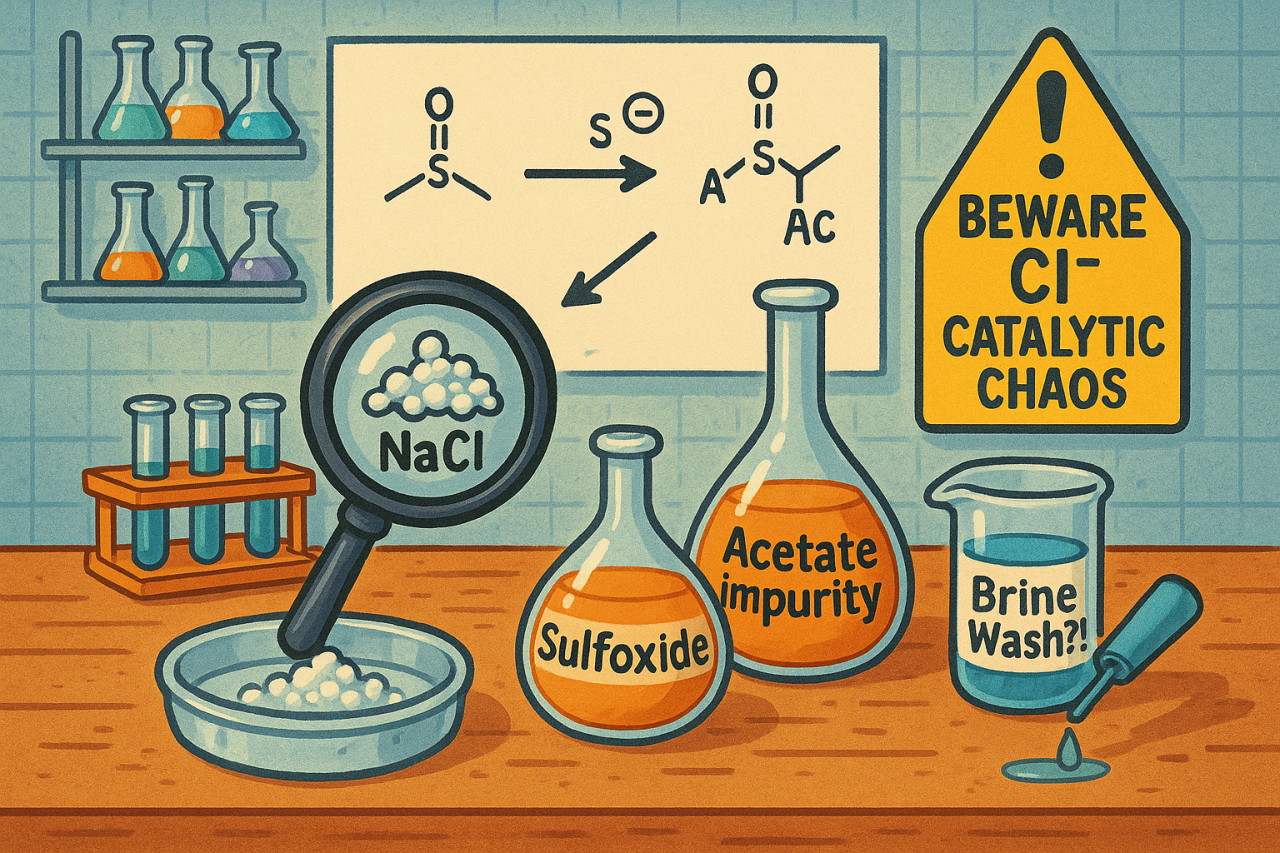
“Looked and tested fine. Dried down. Ready to run. Then… the reaction collapsed.”
It should have worked.
This was not new chemistry. It was the sort of transformation you stop worrying about once it has behaved itself a few times: clean starting material, familiar conditions and nothing especially exotic. The kind of reaction that usually lets you move on without looking back too closely.
And then, without warning, it did not.
Not slow. Not messy. Not even ambiguous. Just wrong.
Instead of converting the sulfoxide cleanly to the intended acetoxy derivative, the reaction slipped into another pathway and produced an unwanted acetate impurity. A dependable Pummerer reaction had not merely become temperamental; it had been completely redirected.
The usual suspects
Moisture was checked. Oxygen was considered. Metal contamination was ruled out. Reagent quality was checked and re-checked. Even deliberate attempts to sabotage the reaction using good starting material failed: the good batch continued to behave perfectly.
The troublesome sulfoxide batch, however, failed again in exactly the same way.
That was the useful clue. Same reagents, same conditions, same procedure; only the batch of starting material had changed.
At that point it stopped feeling like a failed reaction and began to feel like a puzzle. Something else was present. Not a major component, and not anything deliberately added—something carried through during work-up and left behind after concentration.
The clue was crystalline
Careful filtration revealed a white inorganic solid clinging to the apparently dry sulfoxide. It was sodium chloride.
The ethyl acetate extract had retained enough water after the final brine wash to carry a small amount of salt with it. When the extract was concentrated, the solvent disappeared but the chloride did not.
There was not much of it. That was precisely why it had escaped notice. But some impurities do not need to be present in bulk to matter. They participate, redirect and open pathways that compete with—or override— the reaction you intended.
What the chloride was doing
In this system, trace chloride promoted an interrupted Pummerer pathway. The desired product could be reactivated and diverted towards the unwanted impurity, plausibly through sulfonium chloride intermediates.
The important point was not the amount of salt present, but its role. Catalytic quantities were enough to affect the entire batch.
Sulfoxide + trace Cl− → diverted pathway → acetate impurity ✗
From the outside, it looked as though the reaction had failed. In reality, it was following a different set of instructions.
Remove the trace impurity, and everything behaved again. Leave it in, and the chemistry quietly rewrote itself.
Lessons from a lost batch
- “Dry” and “clean” are not the same thing.
- Work-up is part of the chemistry, not something that happens after it.
- A brine wash can leave more behind than expected if the organic phase retains water.
- If one batch behaves differently, assume it is telling you something.
- Crystals in an apparently clean intermediate deserve investigation.
- Trace species can have a disproportionate effect: less than 1% can spoil 100% of the outcome.
- Where chloride contamination is plausible, a simple silver nitrate check may be useful.
It took days of mini-runs, filtration, NMR spectra and head-scratching to identify the culprit.
Sometimes the chemistry is not failing. It is just being quietly redirected by the smallest thing in the flask.
Bonus bench note
Trace inorganic material can also complicate sample preparation and spectral quality. Broad or poorly behaved NMR signals are not proof of salt contamination, but visible residue—or a work-up that may have carried brine forward—is worth checking before blaming the shimming.
Further reading
He, Z.; Pulis, A. P.; Procter, D. J. “The Interrupted Pummerer Reaction in a Sulfoxide-Catalyzed Oxidative Coupling of 2-Naphthols.” Angewandte Chemie International Edition 2019, 58, 7813–7817. DOI: 10.1002/anie.201903492.
This is related mechanistic reading rather than a report of the exact process described in this tale.