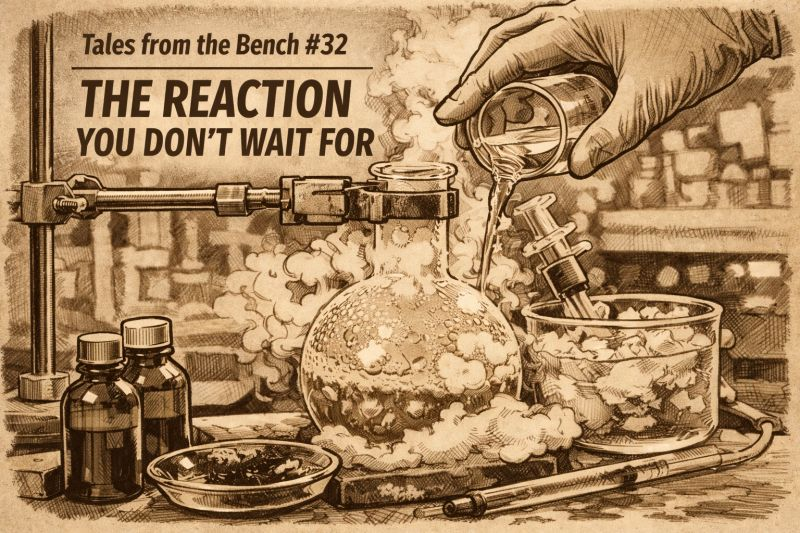
The chemistry did not want attention. It wanted interruption.
This one goes back to late-1990s bench chemistry, when fewer reactions came with guardrails and the flask often delivered its feedback before the analytical department did.
I was preparing a sulfonyl chloride on a heterocycle: solid starting material, aggressive reagents and a transformation that announced itself immediately.
As soon as the components met, the reaction made its presence known: heat, fumes and the unmistakable sense that this was not a “leave it stirring and see how it looks later” situation.
If it had a useful reaction window at all, that window was effectively zero minutes.
A reaction with a trigger
Act promptly—mix, allow the necessary transformation to occur, then quench decisively—and product could be obtained.
Hesitate, even slightly, and the chemistry did not drift gently towards a less satisfactory outcome. It collapsed into black, irrecoverable tar. No work-up could rescue it, and optimism had no measurable effect.
Disciplined execution gave recoverable product.
Waiting did not improve conversion. It destroyed the opportunity.
This was not something to watch.
It was something to stop.
What the tidy method did not show
Looking back now, the surviving laboratory notes present a calm and orderly procedure: controlled additions, brief reaction time and reproducible handling.
What they do not preserve particularly well is the environment in which that method was developed—or the reason those apparently simple instructions mattered so much.
In the 1990s, instant analytical feedback was not part of the rhythm of the bench. Samples entered a queue and results returned when they returned. Optimisation took place through repeated preparations, small adjustments and the gradual accumulation of knowledge about what should never be attempted twice.
In reality, this did not require endless experimentation. Within a handful of iterations, the pattern was clear. The molecule fell apart if the reaction was allowed to sit.
The solution was not to reinvent the chemistry. It was to tighten the execution until the timing became reproducible.
The experienced chemist’s “uh-oh”
In discussion after the original post, another process chemist remarked that the phrase “making a sulfonyl chloride on a heterocycle” was enough to trigger an immediate sense of foreboding: energetic behaviour and black tar are not surprising companions in this territory.
Difficult preparations also have a habit of becoming commercially interesting precisely because other people would prefer not to run them.
Record the reason, not just the recipe
What I most wish had been documented more clearly was not merely what the final method required, but why it had ended up that way.
A method may look obvious while it is fresh in your mind. Years later, the short reaction time can appear arbitrary, the order of addition unnecessarily fussy and the immediate quench merely traditional.
Without context, a future chemist may “improve” away the very feature that made the preparation work.
Preserving process memory
One habit that proved useful was explicitly linking related preparations: a simple “see also prep 275” beside prep 287 can preserve the logic of a sequence and save considerable head-scratching years later.
Thorough notes, clear labels and dates matter most when a preparation turns out to be technique-dependent. Record the observation, but also record the reasoning that converted it into a method.
Lessons learned
- Some reactions do not possess a forgiving holding period.
- Timing can be a process parameter every bit as important as temperature or stoichiometry.
- If a reaction repeatedly becomes tar after a short delay, more waiting is unlikely to be the cure.
- Technique-dependent preparations demand disciplined execution and clear documentation.
- Write down why a method works—not only what was done.
- Cross-reference related preparations so the development history remains visible.
- What feels obvious today may look arbitrary to someone reading the notebook years later.
Some reactions settle or improve if given time. Others briefly behave and then turn on you.
A few only succeed if you know exactly when to intervene—and do not hesitate when that moment arrives.
← Back to all tales