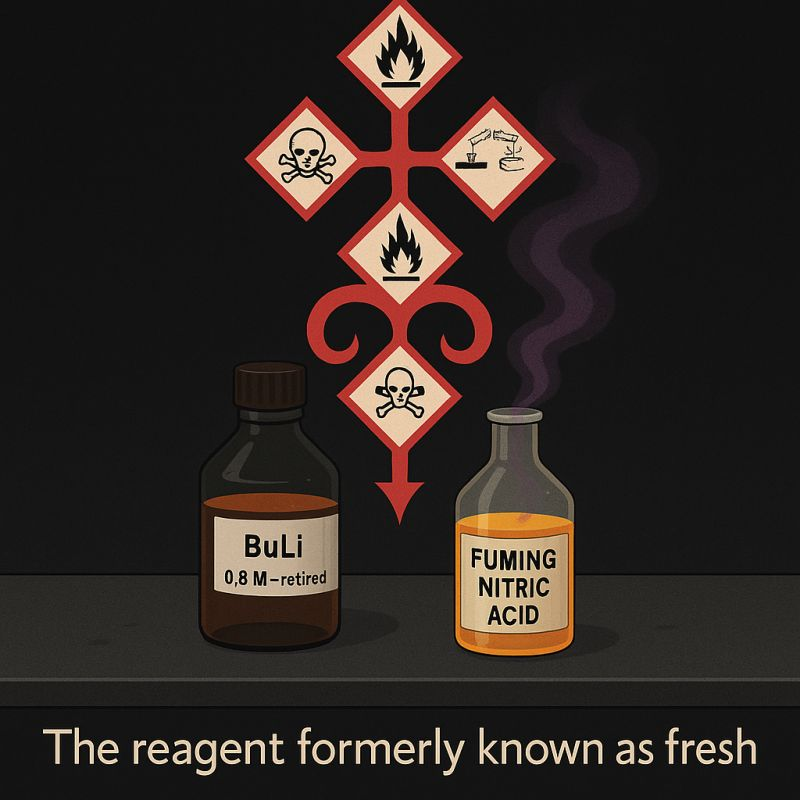
Some bench lessons do not explode. They quietly underperform.
The bottle said n-BuLi, 1.6 M in hexanes.
It was slightly orange, a little crusty around the usual places and faintly cloudy. In other words, it looked sufficiently like a bottle of n-butyllithium that had seen some service.
One addition later, nothing happened.
No convincing colour change. No useful exotherm. Just a sluggish slurry looking back at me as though the expectation of reactivity was somehow unreasonable.
The reaction was meant to begin a straightforward alkylation. Instead, it became an unplanned assay of reagent ageing.
The concentration on the label was historical
The nominal 1.6 M solution was closer to 0.8 M. It still looked like the reagent, and it still possessed enough personality to inspire caution, but much of its useful strength had gone.
The concentration everyone was tempted to assume.
Enough reagent to look familiar; not enough to do the intended job properly.
Oxygen enters. Trace moisture finds its way past septa. Every puncture, transfer and moment exposed to imperfect handling history takes something from the reagent.
“Fresh” is not a binary property. A bottle does not move neatly from vigorous to dead. It weakens, often without announcing the change in a way that can be trusted by eye alone.
Fresh stock was obtained, the reaction was repeated, and everything behaved perfectly. The only material loss was time; the only personal casualty was a small amount of confidence.
The amber glow of misplaced confidence
Anyone who has handled organolithium reagents knows the temptation to use colour as a shorthand assessment. Swirl the bottle, inspect the solution, decide it looks close enough and carry on.
Visual inspection is useful. Darkening, solids, damaged closures or anything else that looks wrong should not be ignored. But colour is not concentration, and an apparently plausible appearance is not an assay.
I used to write the date first opened on every bottle. It was a small habit, but a useful reminder that time and handling history belong in the reaction record just as surely as solvent and temperature.
Other reagents perform long after their chemistry fades
The same trap appears elsewhere in the laboratory. A reagent may continue to display the colour, fumes or general theatricality associated with its name even after its useful composition has changed.
Fuming nitric acid was the comparison I made in the original tale: visible fumes can continue to look impressive while concentration and oxidising behaviour no longer match the assumption being made from appearance alone.
Chemistry enjoys a disguise. Colour, smell and bravado are surface traits; concentration, contamination and kinetics make the decision.
What the discussion added
Retest by risk
One laboratory introduced periodic retesting based on reagent reactivity, handling history and the simple observation that a container no longer looked or felt right.
Date-sensitive solvents
Ether bottles were dated when first opened and monitored for peroxide formation, turning age into a visible safety parameter.
Buy less, discard sooner
Smaller containers for occasional use and regular stock clean-outs reduce the population of forgotten reagents quietly ageing on shelves.
Eyes are useful—not quantitative
Appearance can warn that something is wrong, but careful stoichiometry still requires titration or another appropriate assay.
Commercial LDA
The discussion also noted that freshly prepared LDA can be preferable to relying on an aged, dark commercial solution of uncertain quality.
Solids are a message
Visible solids in a sensitive organolithium reagent are not an invitation to optimism. They are usually a reason to reassess, quench safely and replace the bottle.
For the satirical literature file
No account of ageing “1.6 M” organolithium would be complete without The Smythe Reagent: ~1.6 M LiOH in Hexane—a sharply observed piece of chemical satire about bottled bravado and concentration by reputation.
Read “The Smythe Reagent: ~1.6 M LiOH in Hexane”Lessons learned
- Test or titrate when concentration matters.
- Colour is not concentration.
- Age and handling history quietly reduce reactivity.
- Date sensitive reagents when they are opened.
- Use smaller containers when a reagent will only be needed occasionally.
- Retest or replace stock that looks wrong, behaves wrongly or has simply been around too long—and, for heaven’s sake, don’t just put it back in the cupboard or fridge for the next person.
- If a reagent bottle inspires nostalgia, it may be time to retire it.
Sometimes the scariest reagents do not explode. They sit quietly in the bottle, waiting for someone to assume they still can.
The bottle never shouts. It simply lets the reaction deliver the bad news.
← Back to all tales