The AI’s reasoning sounded airtight. That was the problem.
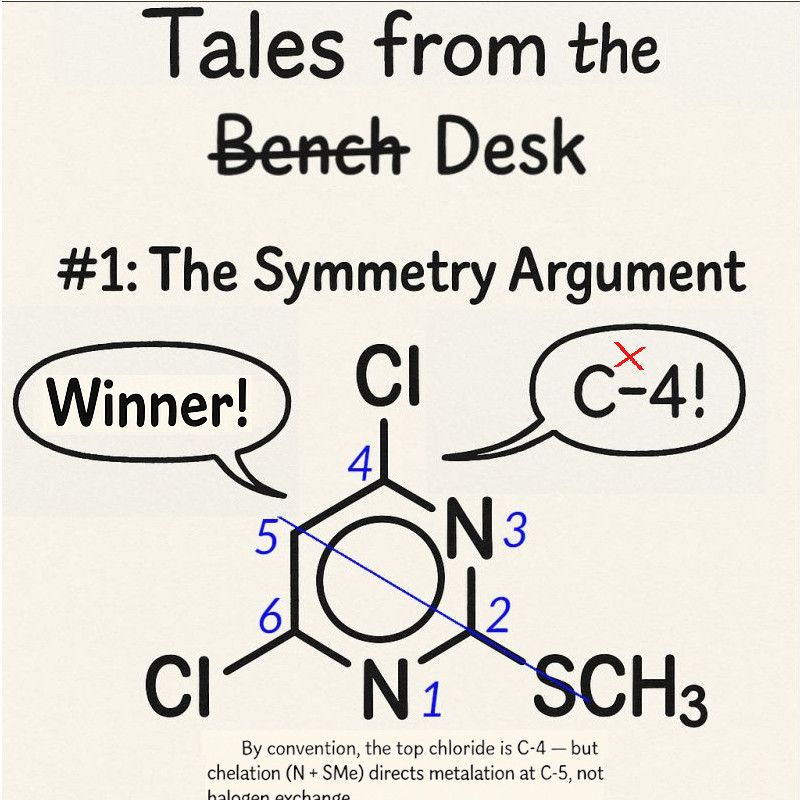
The molecule was 2-(methylthio)-4,6-dichloropyrimidine.
My instinct was that treatment with Turbo-Grignard, i-PrMgCl·LiCl, would metalate at C-5: the proton sitting between the two chlorides on the heteroaromatic ring.
It felt chemically plausible. The site looked electronically activated, and the apparent symmetry of the two chlorides made the AI’s later focus on one numbered chloride seem suspicious.
But instinct is not evidence, so I decided to sanity-check it.
Enter AI.
A deliberately simplified sketch: the dispute was whether Turbo-Grignard would metalate C-5 or somehow favour reaction associated with C-4.
C-5 metalation
The proton between the two chlorides appeared to be the obvious site. The chlorides remain in place; metalation and subsequent formylation occur at C-5.
C-4 reactivity
It proposed a directing interaction involving SMe and a ring nitrogen, presented as a five-membered coordination arrangement that would bias reaction towards C-4.
The persuasive wrong hill
We argued.
I pointed to the apparent equivalence of the two chlorides and kept returning to C-5 acidity. The AI insisted that numbering was beside the point and that literature precedent supported C-4 exchange.
It even supplied a real paper and a plausible abstract. I checked: the paper existed. On a quick reading, its argument appeared close enough to the present case to be persuasive.
Back and forth we went until the counter-argument began to sound more rigorous than my own instinct. Eventually I allowed myself to be convinced.
That was not because the answer had been demonstrated. It was because it had been expressed with confidence, structure and supporting detail.
Then the chemistry answered
My original instinct had been right.
The AI’s proposed C-4 story was not merely a slightly different way of describing the same outcome. It had selected the wrong pathway and then constructed an elegant rationale around it.
In particular, its proposed five-membered chelation picture did not fit the geometry of this scaffold as neatly as the prose suggested. The SMe group at C-2 and the relevant ring positions were too distant for the simple directing model it had borrowed from other systems.
A necessary mechanistic caution
The experimental outcome established the site of reaction more securely than it established one uniquely correct mechanistic cartoon.
A better account places greater emphasis on the acidity and electronic stabilisation of C-5, influenced by the heteroaromatic nitrogens and the two chloro substituents, together with ion-pairing or coordination effects in the Turbo-Grignard system.
Several experienced chemists questioned whether the methylthio group could reasonably be described as directly “chelating” the reagent into position. Any S→Mg contribution is better treated as a possible small bias than as a complete explanation. The result was clear; the precise balance of interactions remained subtler.
Why the error was so convincing
The AI had not produced nonsense. It had taken a chemically familiar rule, found literature that looked adjacent to the problem, and assembled a coherent explanation.
That is exactly why this kind of failure is dangerous.
A blatantly absurd answer is easy to reject. A polished answer built from real concepts, a real citation and one incorrect transfer of context is much harder.
The mistake also developed during an ongoing conversation rather than a fresh session. Earlier context may have nudged the model towards a particular framing, after which each exchange reinforced the same hill.
Humans do something similar. We form a hypothesis, search for support, find a partial fit and slowly become more certain because the argument is becoming more elaborate—not necessarily because it is becoming more true.
What the discussion added
Run the experiment
A short period at the bench can resolve what pages of argument cannot. Chemical reasoning guides the experiment; it does not replace it.
Challenge what you know
The fact that the AI was wrong does not make external challenge unhelpful. Good projects often begin when an accepted assumption is tested.
Mechanisms need humility
Knowing the product does not automatically prove every detail of the proposed coordination or transition-state picture.
Context can steer the answer
Prompt wording and previous conversation may quietly bias which analogy an AI reaches for and then defends.
Numbering is not causation
Molecules do not react because a site is called C-4 or C-5. Numbering describes the structure; electronics, acidity, kinetics and geometry determine behaviour.
Confidence is not correctness
The most eloquent participant can win the debate while standing on the wrong side of the reaction scheme.
Lessons learned
- Use AI as a sparring partner, not an experimental result.
- A real citation does not guarantee that the cited chemistry applies to the present scaffold.
- Generic directing rules can fail when geometry and electronics differ from the precedent.
- Separate an observed regioisomer from the mechanism proposed to explain it.
- Start a fresh conversation when earlier context may be biasing a new chemical problem.
- Trust chemical instinct enough to test it—but not enough to stop checking.
- Persuasive and correct are independent properties.
No solvent was spilled and no product was carbonised. Only pride took a small knock.
But it was a useful reminder: AI can defend the wrong hill beautifully, and a chemist can still be talked into climbing it.
The molecule, meanwhile, remained entirely unmoved by the quality of the prose.
← Back to all tales