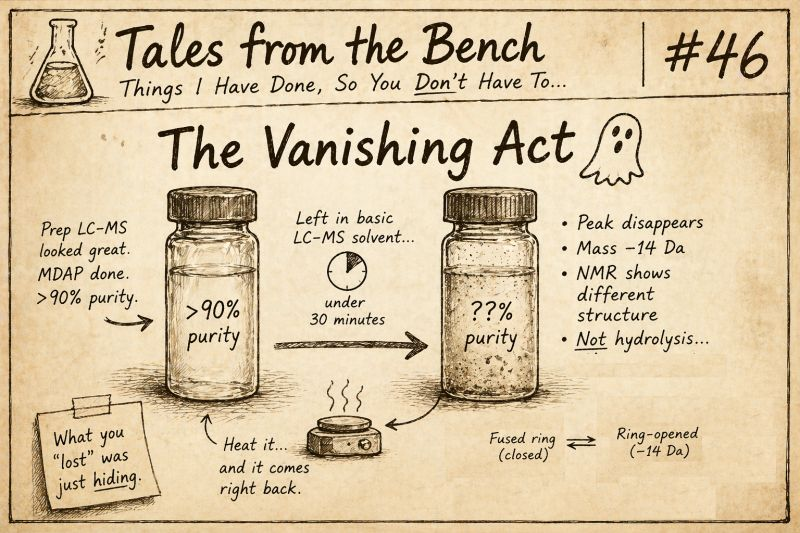
From more than 90% purity to mystery mush in under half an hour.
It looked like a win.
The preparative LC–MS team had teased clean material from crude reaction mixtures that were, in places, decidedly ambitious. Some contained barely 7% of the desired product. After mass-directed autopurification, the UPLC traces showed what everyone wanted to see: material comfortably above 90% purity.
It felt earned.
Then we tried to dry it.
In fact, we did not even get that far. Simply leaving the collected fractions standing in the basic LC–MS solvent was enough. The purity began to unravel—quietly at first, then rapidly enough that it could not be ignored.
The first clue was 14 Da
Mass spectrometry gave the first useful clue. The principal ion was now 14 Da lighter than expected. This was not a minor background component or an unrelated impurity. The product itself appeared to have changed.
The first explanation seemed obvious. The fractions contained basic aqueous acetonitrile, with amine modifiers present, and the target contained functionality that made ester hydrolysis look entirely plausible. The mass difference appeared to fit, and the story was neat enough to be convincing.
Except the material did not behave as though it had been hydrolysed.
It came back
On warming, the expected mass returned. The NMR spectrum followed suit: clean and consistent with the intended material, with no sign that a carboxylic acid had been formed and then somehow politely reversed itself.
Hydrolysis does not normally undo itself that neatly.
So whatever had apparently been lost was not gone.
The structure mattered
The target contained a morpholine-like fused ring: the sort of structural feature that behaves perfectly well until the surrounding conditions encourage it not to.
Under the basic collection conditions, the ring was opening reversibly. The compound was not being destroyed permanently, but the equilibrium was shifting towards a form with different ionisation behaviour. That change was enough to produce the consistent −14 Da shift in the observed [M+H]+ ion.
Leave the fractions standing and the expected peak appeared to vanish. Warm the material gently and the original form returned as though nothing had happened.
The chemistry had not disappeared. The analytical conditions had changed which version of it we were observing.
The irony of better chromatography
The basic conditions had been my choice.
They produced sharper peaks, cleaner separations and much better resolution across a particularly awkward impurity profile. Acidic conditions had given broad, unhelpful separation—and there were a great many impurities to resolve.
I thought I was doing the prep team a favour.
To their credit, they still delivered across roughly fifty different variants. They know who they are, and they also know that biscuits remain part of the outstanding settlement.
Changing the conditions
Later, one derivative was resynthesised and deliberately challenged under acidic LC-type conditions: 0.1% formic acid in acetonitrile and water.
It remained stable for several days at room temperature. Reverse-phase purification worked, the −14 Da shift did not appear, and the disappearing act was finally cancelled.
Lessons learned
- Basic LC–MS solvents can quietly unravel sensitive fused-ring systems.
- A −14 Da mass shift is not automatically evidence of hydrolysis.
- If the expected material returns, question the proposed irreversible mechanism.
- Sharp peaks are not worth much if the compound does not survive the method.
- Product stability matters just as much as chromatographic separation.
- Check analytical and purification conditions before committing larger amounts of material.
- Sometimes the thing you “lost” was merely hiding in another state.
Other spectral ghosts
Not every vanishing product is undergoing reversible chemistry. In a related laboratory discussion, another chemist recalled a novel small molecule that was present in the crude reaction but disappeared during work-up. The closest known analogue boiled below ethyl acetate—the solvent being removed. Sometimes the precious product has not decomposed at all; it has simply evaporated before its time.
The right lens
A later discussion compared the episode, loosely, to Schrödinger’s cat: until the conditions change, it may not be obvious which version of the system is being observed.
The comparison is playful rather than literal, but the analytical lesson is sound. A method does not merely report on a compound from a safe distance. Its solvent, pH, temperature and timescale may determine the state in which that compound is seen.
Sometimes you hand over gold and watch it briefly turn back into base metal.
Fortunately, this time, a little warmth was enough to reverse the alchemy.
← Back to all tales