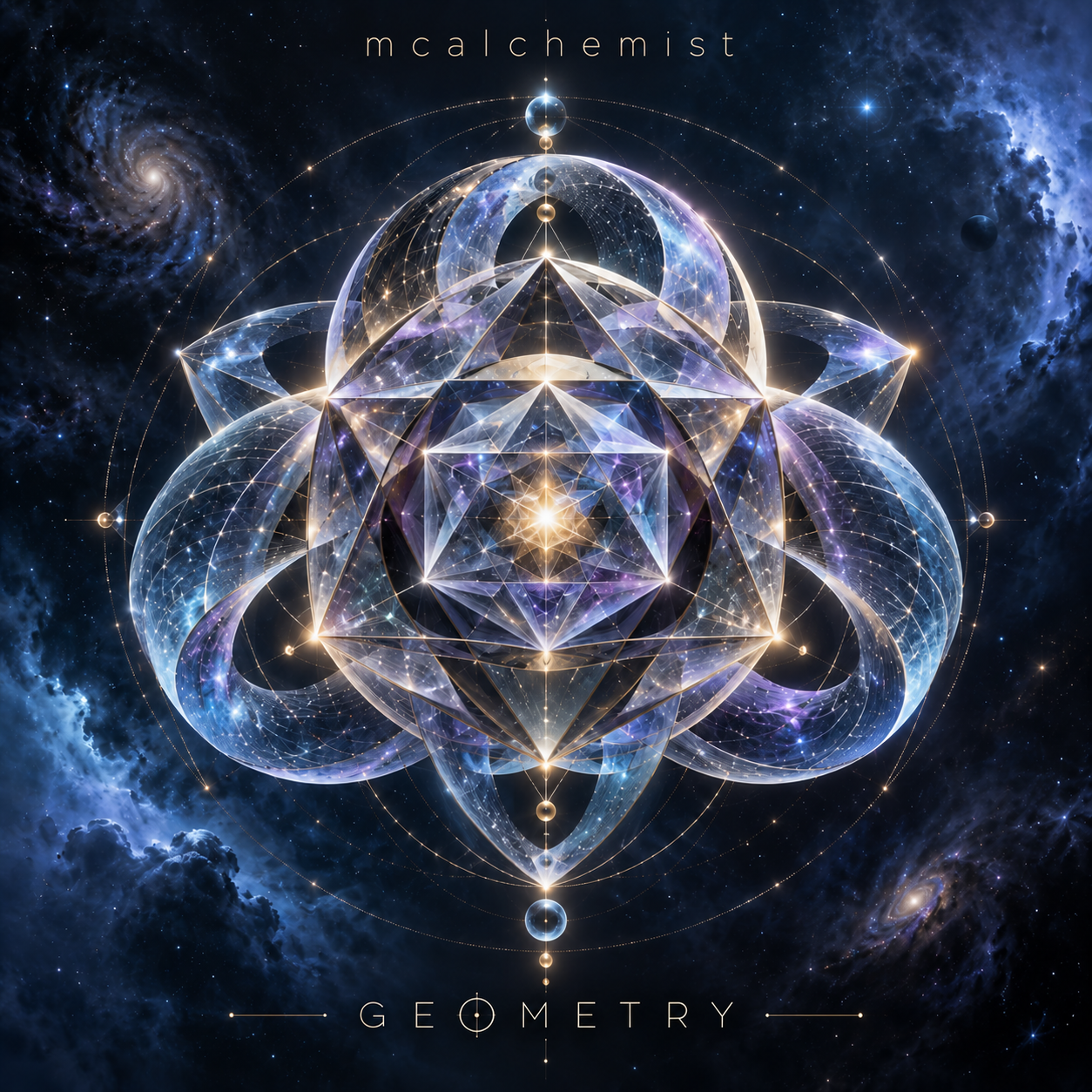
FIELD NOTES: GEOMETRY_01 // FORMS IN SOUND
GEOMETRY asks a simple question:
If a shape could organise sound, what would it choose to become?
Each track begins with a geometric form, surface or structure and translates one of its characteristic behaviours into music. The result is not strict mathematical sonification: vertices are not mechanically assigned to notes, nor are equations merely converted into pitch. Instead, recurrence, recursion, non-periodicity, orientation, curvature, duality, entanglement and dimensionality become compositional instructions.
The geometry supplies the behaviour; the AI interprets it as sound; the human role is to choose the form, define the analogy, listen, refine and select the interpretation that best expresses the idea.
GEOMETRIC LOGS:
Circle: The simplest closed curve: every point lies the same distance from its centre.
Sonic behaviour: recurrence and return; the composition travels outward through layers and motion before approaching the state from which it began.
Spiral: A curve revolving around a centre while continually moving towards or away from it.
Sonic behaviour: repeated ideas return at changing register, density and intensity, creating circular motion that is also a journey.
Möbius Strip: A surface with one side and one boundary. Follow it continuously and an apparent opposite side is reached without crossing an edge.
Sonic behaviour: familiar material gradually inverts and changes orientation without an obvious break, returning recognisably altered.
Sierpiński Triangle: A fractal generated by recursively removing smaller triangles from a larger triangle, producing self-similarity across scale.
Sonic behaviour: small motifs reproduce themselves as faster and slower layers, phrases and larger structures — musical patterns nested inside patterns.
Penrose Lattice: Based on Penrose tiling: an ordered, non-periodic arrangement capable of extending indefinitely without repeating by simple translation.
Sonic behaviour: short cells continually recur and recombine, giving the impression of recognition while refusing to settle into a predictable loop.
Torus: A ring-shaped surface generated by rotating a circle about an axis outside the circle.
Sonic behaviour: independent cyclic sequences wind around one another, repeatedly drifting into and out of alignment while maintaining continuous rotational motion.
Klein Bottle: A non-orientable surface with no conventional distinction between inside and outside. A true Klein bottle requires four dimensions to exist without self-intersection.
Sonic behaviour: foreground becomes background, near becomes distant and apparently separate layers exchange roles until musical orientation becomes uncertain.
Trefoil Knot: The simplest non-trivial mathematical knot: a closed loop crossing over itself three times and unable to be untangled into a simple circle without cutting it.
Sonic behaviour: three strands twist, cross and exchange identities. Rhythmic displacement, detuning and controlled dissonance create tension where the strands intersect.
Dodecahedron: A regular Platonic solid composed of twelve pentagonal faces.
Sonic behaviour: recurring five-note cells, layered sequences and slowly changing perspectives suggest a large faceted object rotating through space.
Icosahedron: A regular Platonic solid composed of twenty triangular faces, and the geometric dual of the dodecahedron.
Sonic behaviour: sharper three-note figures, rapid shifts and crystalline layers offer a more agile counterpart to the broader Dodecahedron.
Gyroid: A triply periodic minimal surface: a continuous labyrinth of smooth saddle-like passages repeating through three-dimensional space, without straight lines and without dividing space into a simple inside and outside.
Sonic behaviour: interwoven musical pathways continually diverge, curve, reconnect and flow through one another, complex but never simply chaotic.
Hyperbolic Paraboloid: A saddle-shaped surface curving upward in one direction while curving downward in the perpendicular direction.
Sonic behaviour: opposing motions coexist — ascent against descent, expansion against contraction, widening space against tightening rhythm.
24-Cell: A regular four-dimensional polytope composed of twenty-four octahedral cells. Unlike the familiar Platonic solids, it has no regular three-dimensional counterpart.
Sonic behaviour: the finale treats the music as a projection of something that cannot be completely represented in ordinary space. Earlier geometric behaviours return in unfamiliar relationships, building toward a structure intended to feel larger than the dimensions available to hear it.
SUPPLEMENTARY NOTE: THE SINGLE-WORD EXPERIMENT
During work on Geometry, an alternative version of
Dodecahedron was generated using almost no compositional
instruction at all.
Instrumental. Dodecahedron
That was the complete prompt.
The result was unexpectedly convincing, but markedly different from
the deliberately designed geometric interpretation used for the main
album. It raised another question:
What happens when the AI is given a single word and left entirely
to decide what that word should sound like?
That small experiment subsequently developed into a separate project.
Words were selected for their imagery, ambiguity, emotional associations,
unusual meanings or sheer difficulty of interpretation, and each was
submitted with no musical direction beyond the instruction that the
result should be instrumental.
The AI was therefore not asked to reproduce a predefined musical idea.
It was asked only to interpret what the word invoked.
In that sense, the bonus version of Dodecahedron became both
an alternative interpretation and the accidental starting point for
another experiment.
// EXPERIMENT STATUS: PROPAGATED
GEOMETRY BECAME LANGUAGE.
One word was enough.
What begins with a circle gradually leaves intuitive space behind: curves become surfaces, surfaces become knots and labyrinths, solids acquire duals, and the final projection belongs to four dimensions.
// CLASSIFICATION: PROJECTED
THE FORM HAS BEEN GIVEN SOUND.
Orientation is no longer guaranteed.