Card 001
English translation
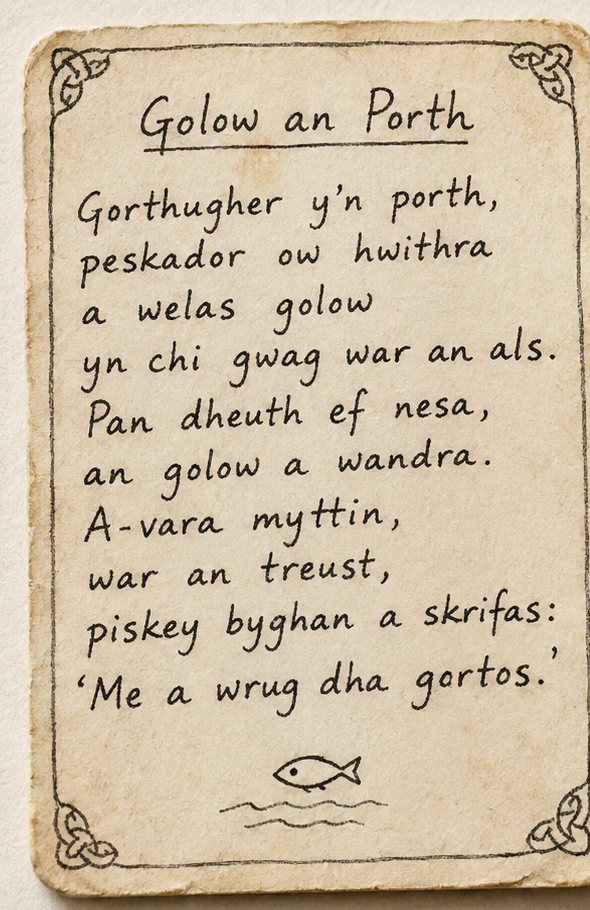
The Harbour Light
At dusk in the harbour,
a fisherman, whistling,
saw a light
in an empty house on the cliff.
When he came nearer,
the light wandered away.
The next morning,
on the windowsill,
a tiny fish had written:
“I waited for you.”
Language notes
- The handwriting is neat and rounded, with a lightly informal print-cursive character and small decorative doodles. Similarities of hand may become useful as more cards are compared.
- “Porth” is used for a harbour or creek, while “gorthugher” is an older form for evening.
- The story offers no explanation for the wandering light or the message left behind.
Possibly odd, not necessarily wrong:
By morning, a tiny fish appears to have left a written message on the windowsill.
Card 002
English translation
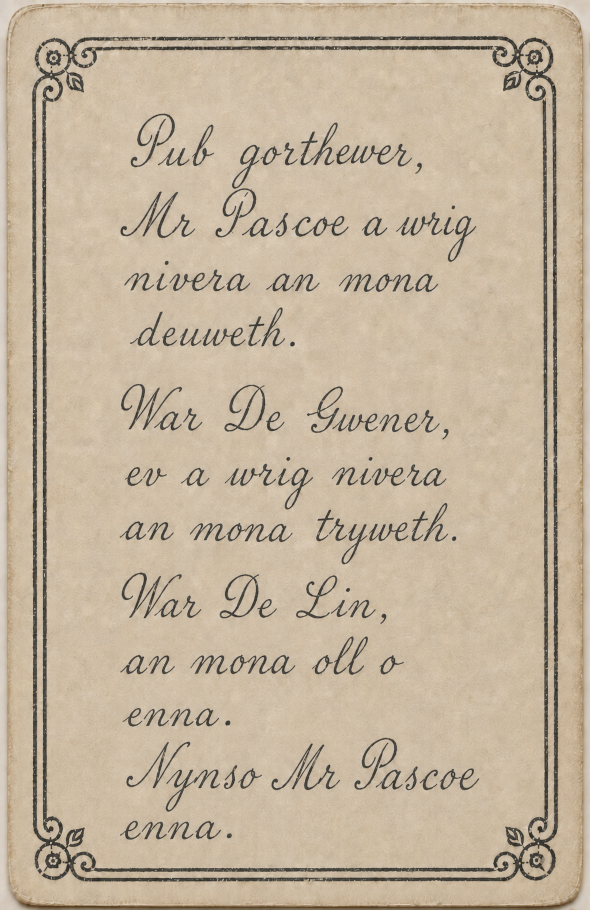
Mr Pascoe
Every evening Mr Pascoe counted the money twice.
On Friday he counted it three times.
On Monday all the money was there.
Mr Pascoe was not.
Language notes
- The hand is unusually formal and controlled, with carefully formed capitals and very even spacing. It suggests someone trained in a fairly strict schoolroom hand. Similarities in handwriting may become useful as more of the cards are compared.
- Several forms are readily found in Jenner-era Cornish: “gorthewer” for evening, “De Gwener” for Friday, “De Lin” for Monday, and “deuweth” and “tryweth” for twice and three times. The repeated “a wrig + infinitive” construction is also characteristic of later Cornish.
- “Mona” is used for money. As with much early-revival Cornish, precise spelling and vocabulary can be difficult to pin down consistently, and the surviving sources do not always point to one uniquely correct form.
Possibly odd, not necessarily wrong:
On Monday the money is all present. Mr Pascoe is not.
Card 003
English translation
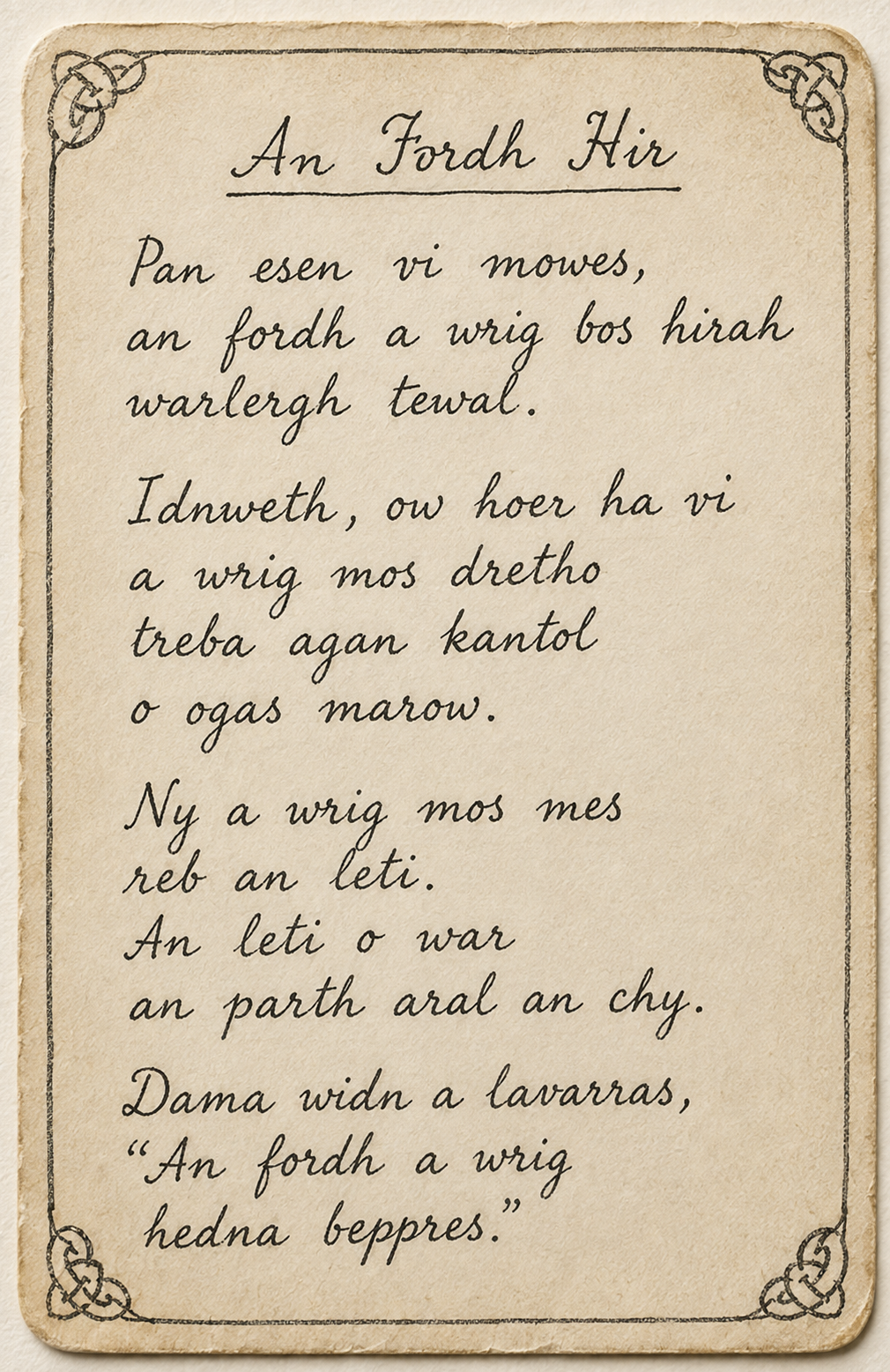
The Long Passage
When I was a girl, the passage grew longer after dark.
Once my sister and I walked through it until our candle was nearly gone.
We came out beside the dairy.
The dairy was on the other side of the house.
Grandmother said, “The passage always did that.”
Language notes
- The handwriting is an older, well-practised cursive hand: confident and highly legible, but with slightly looser spacing and pressure than some of the other cards. It has the character of someone accustomed to writing at length.
- “Mowes” means girl, “hoer” sister, and “dama widn” grandmother. “Beppres” is an older form meaning always. The construction “Pan esen vi mowes” gives the sense “when I was a girl.”
- The story is presented as a memory from the writer’s childhood, apparently already an old family story by the time it was written down.
Possibly odd, not necessarily wrong:
The passage does not merely seem longer: it delivers the girls to the wrong side of the house, and Grandmother appears to regard this as perfectly normal.
Card 004
English translation
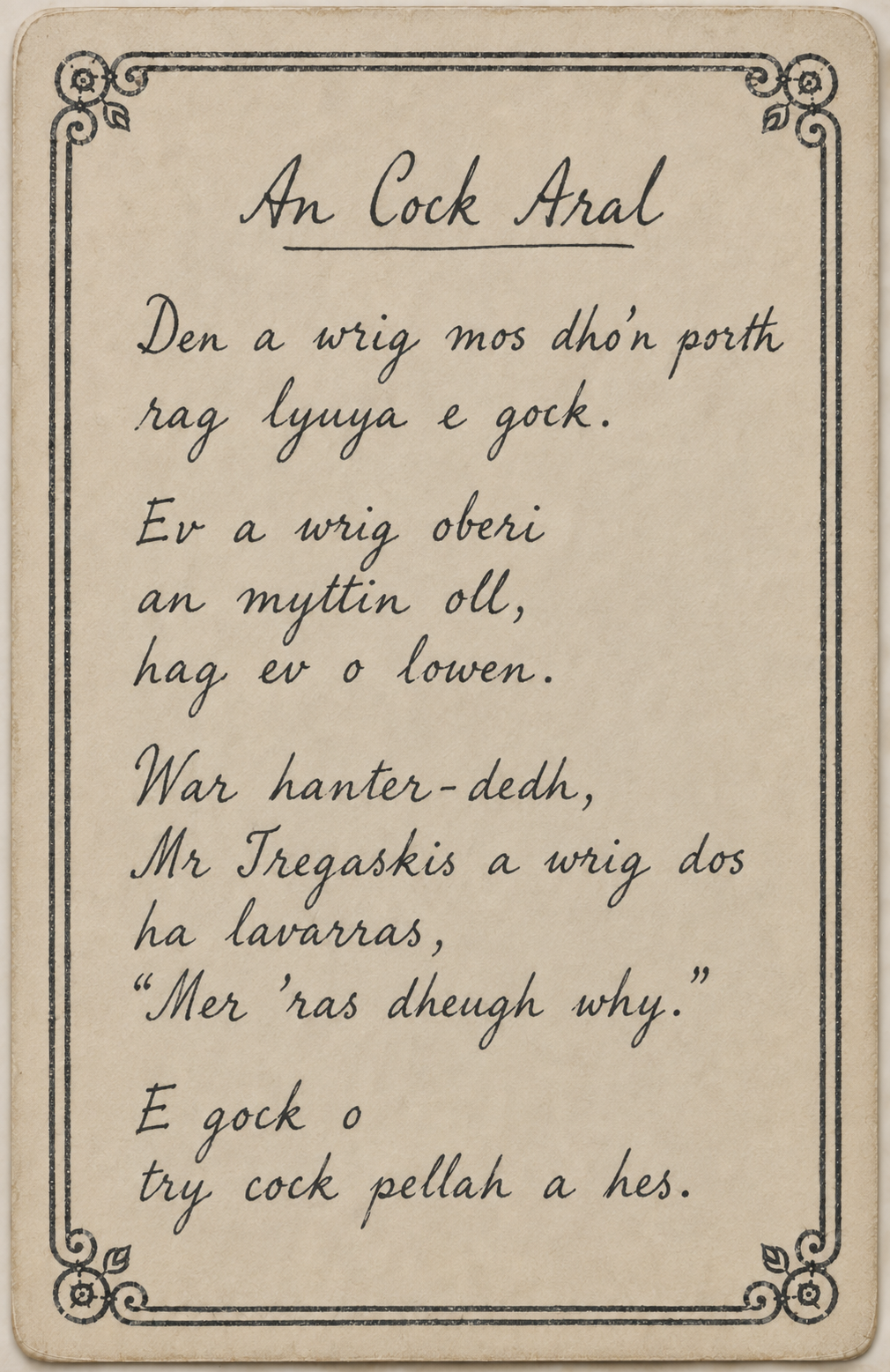
The Wrong Boat
A man went down to the harbour to paint his boat.
He worked all morning and was very pleased with it.
At noon Mr Tregaskis came and thanked him kindly.
His own boat was three boats further along.
Language notes
- The handwriting is lively and competent, but rather less controlled than some of the other cards. The spacing varies slightly and the joins have a quicker, more energetic quality, suggesting someone writing with confidence rather than particular care.
- “Porth” is used for a creek or harbour, while “cock” is an older word for boat. Jenner quotes the latter in a surviving Cornish song about pilchard fishing.
- “Hanter-dedh” means midday. “Mer ’ras dheugh why” is the familiar Cornish expression for “thank you.”
- The Cornish title, “An Cock Aral”, literally means “The Other Boat” rather than “The Wrong Boat”.
Possibly odd, not necessarily wrong:
Mr Tregaskis appears to have acquired a freshly painted boat entirely by accident.
Card 005
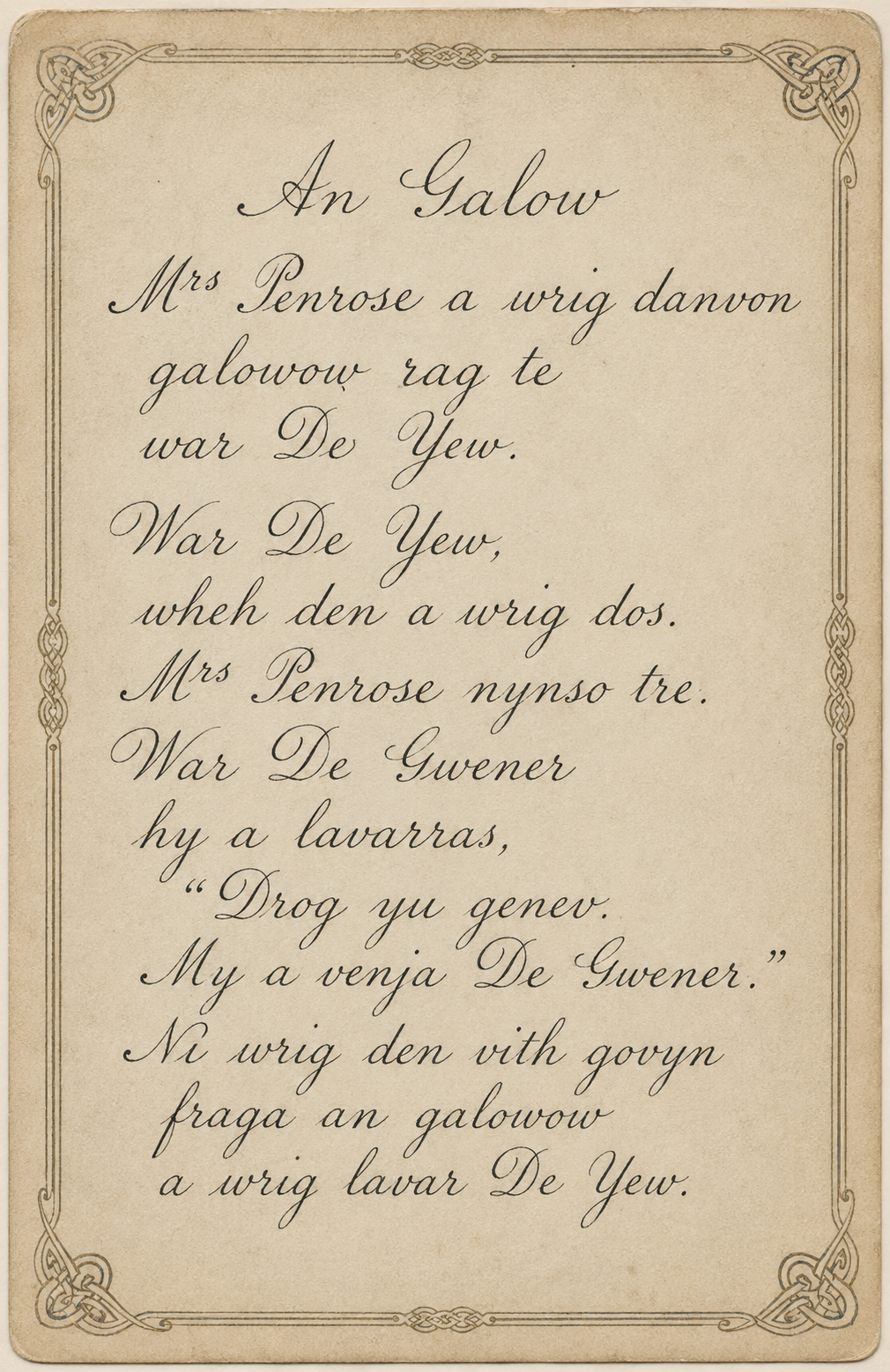
English translation
The Invitation
Mrs Penrose sent invitations to tea on Thursday.
On Thursday, six people came. Mrs Penrose was out.
On Friday she said, “I am sorry. I meant Friday.”
Nobody asked why the invitations said Thursday.
Language notes
- The handwriting is unusually formal and controlled, with carefully formed capitals, elegant joins and very even spacing. It bears a noticeable resemblance to the hand on at least one earlier card.
- “De Yew” is Thursday and “De Gwener” Friday. After a numeral Cornish normally leaves the following noun singular, hence “wheh den” for six people.
- “Drog yu genev” is an idiomatic way of saying “I am sorry”. “Venja” comes from “menny”, to wish or intend.
- The title “An Galow” means “The Invitation”.
Possibly odd, not necessarily wrong:
Mrs Penrose may simply have made a mistake. The unexplained Thursday written on every invitation is what makes the story rather less comfortable.
Card 006
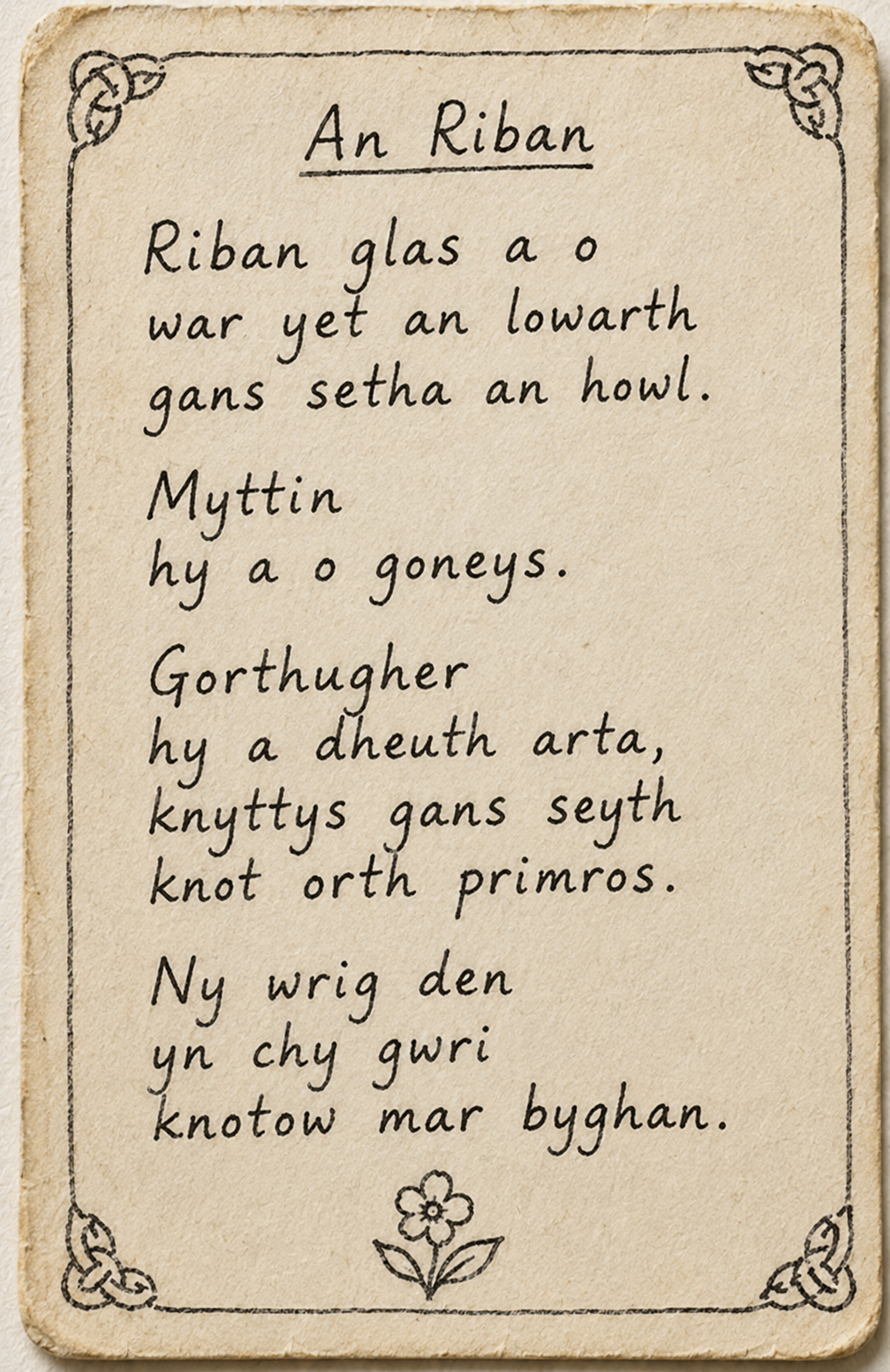
English translation
The Ribbon
A blue ribbon was left on the garden gate at sunset.
In the morning it was gone.
At dusk it came back, tied in seven knots round a primrose.
Nobody in the house could tie so small.
Language notes
- The handwriting is neat, rounded and very legible, with a warm, youthful print-cursive character. It closely resembles the hand seen on another of the more playful cards in the collection.
- The small flower doodle at the foot of the card suits the subject and is typical of the little decorative additions found on some of the more personal hands.
- “Myttin” is morning and “gorthugher” evening. “Seyth” gives the number seven.
- The tone is folkloric rather than overtly supernatural: the story leaves open whether the ribbon was taken by small folk, by some household mischief, or by someone with remarkably patient fingers.
Possibly odd, not necessarily wrong:
The final line is the sting: the mystery is not simply that the ribbon returned, but that it came back tied in knots too small for anyone in the house to manage.
Card 007
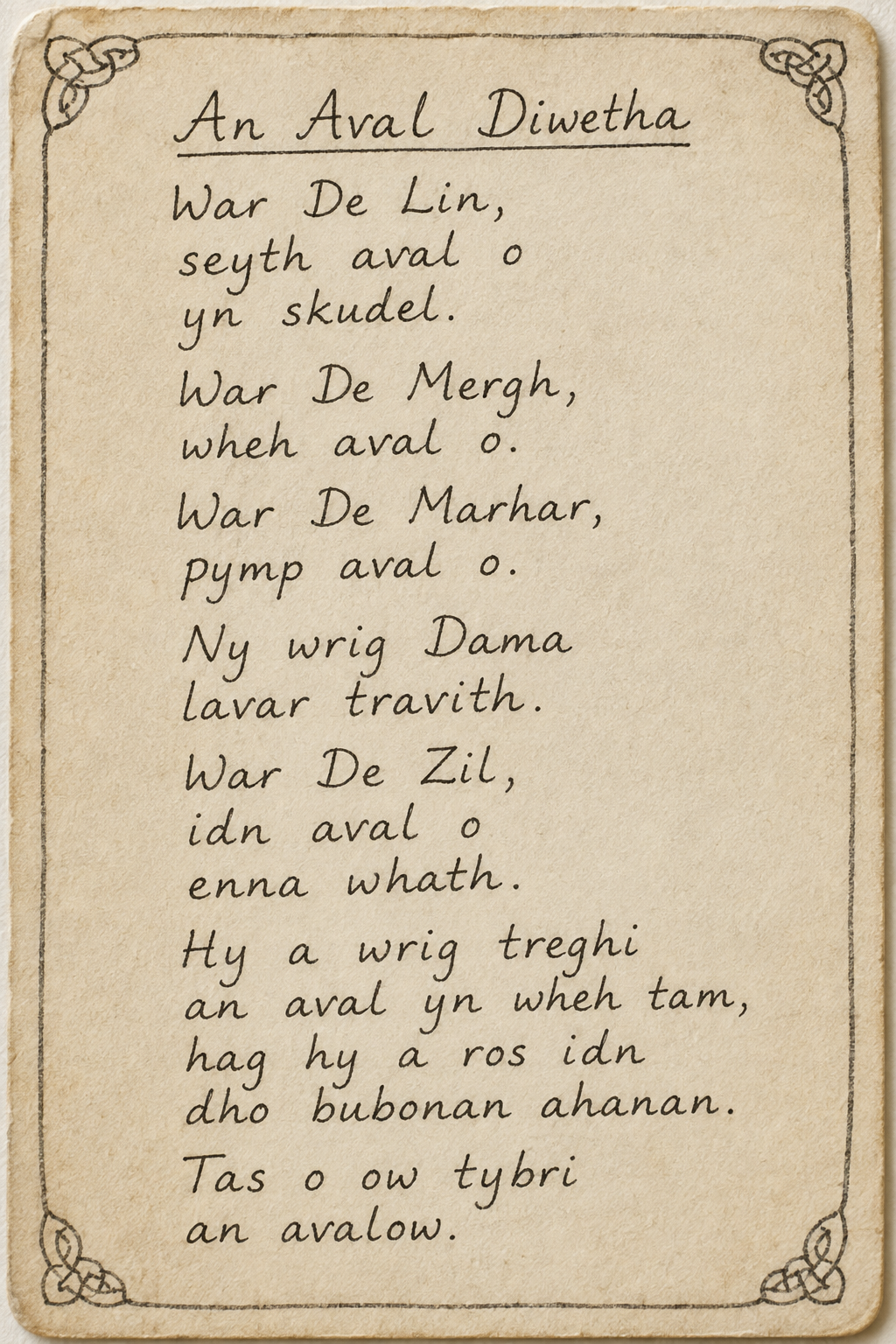
English translation
The Last Apple
There were seven apples in the bowl on Monday.
On Tuesday there were six. On Wednesday there were five.
Mother said nothing.
On Sunday one apple remained.
She cut it into six pieces and gave one to each of us.
Father had been eating them.
Language notes
- The handwriting is a mature, clear and assured cursive hand. It is tidy without being particularly ornamental, with the appearance of someone accustomed to ordinary correspondence rather than formal display writing.
- “De Lin”, “De Mergh” and “De Marhar” are Monday, Tuesday and Wednesday. “De Zil” is Sunday. “Dama” is used for mother and “Tas” for father.
- The steadily diminishing numbers — seven, six, five, and finally one — give the card an almost suspiciously methodical beginning.
- The title “An Aval Diwetha” means “The Last Apple”.
Possibly odd, not necessarily wrong:
There is no mystery after all. Father had simply been eating the evidence.
Card 008
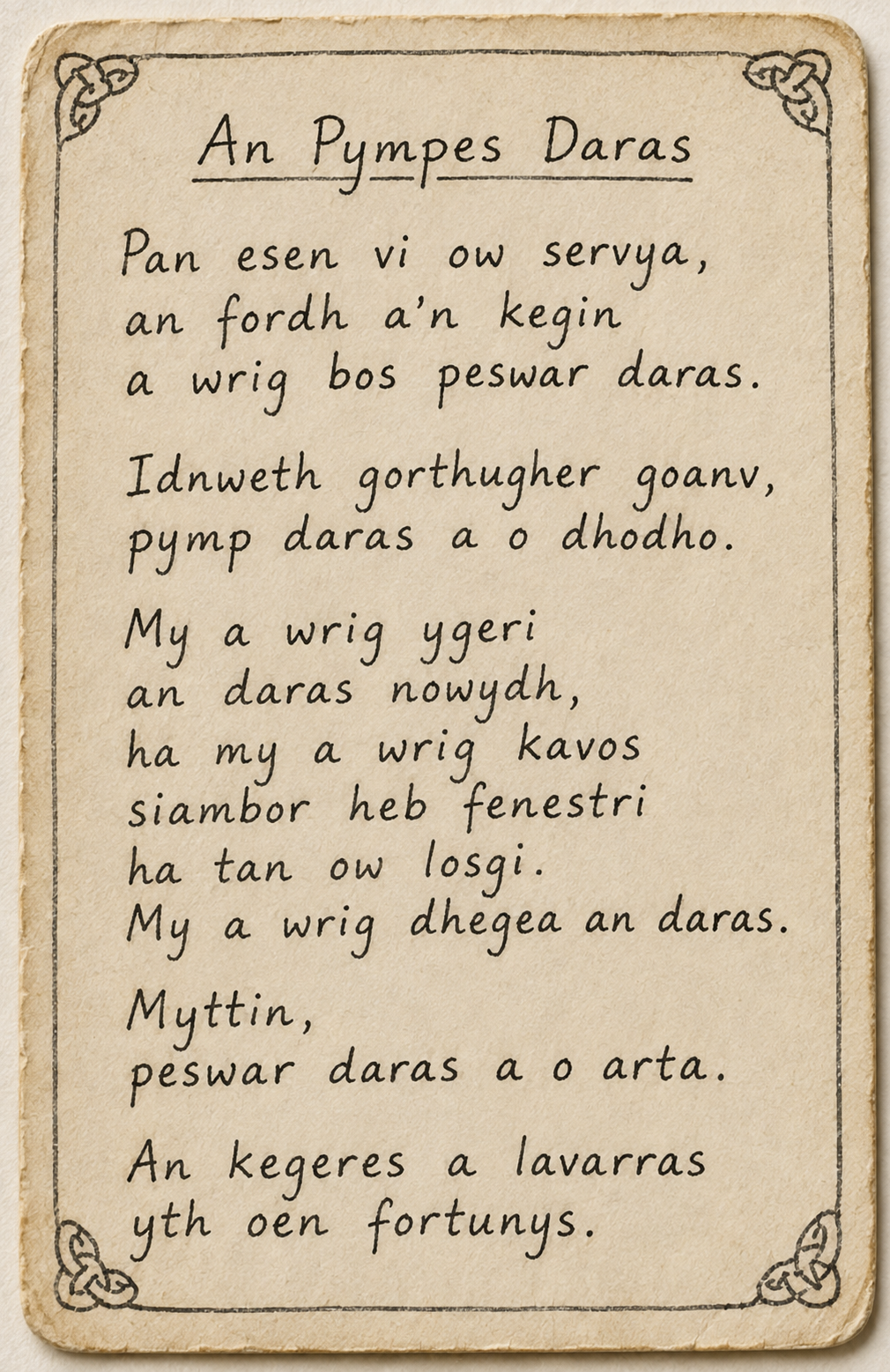
English translation
The Fifth Door
When I was in service, the kitchen passage had four doors.
One winter evening it had five.
I opened the new one and found a room with no windows and a fire burning.
I shut the door.
In the morning there were four again.
Cook said I was lucky.
Language notes
- The hand is firm, practical and highly legible, with comparatively little ornament. The spacing and baseline are less formal than on some of the other cards, suggesting a confident writer accustomed to everyday notes rather than careful display writing.
- “Idnweth” gives once, while “gorthugher” is evening. The language again shows the mixture of later Cornish forms and early-revival usage found elsewhere in the collection.
- The opening places the incident during an earlier period in the writer’s life, when she was in domestic service, but gives no date.
- This is not the first surviving card to describe a passage behaving in a way inconsistent with the building around it.
Possibly odd, not necessarily wrong:
The unexplained fifth door is peculiar enough. Cook’s remark suggests that opening it may not have been the worst thing that could have happened.