The Invisible Cities
M.C. ALCHEMIST
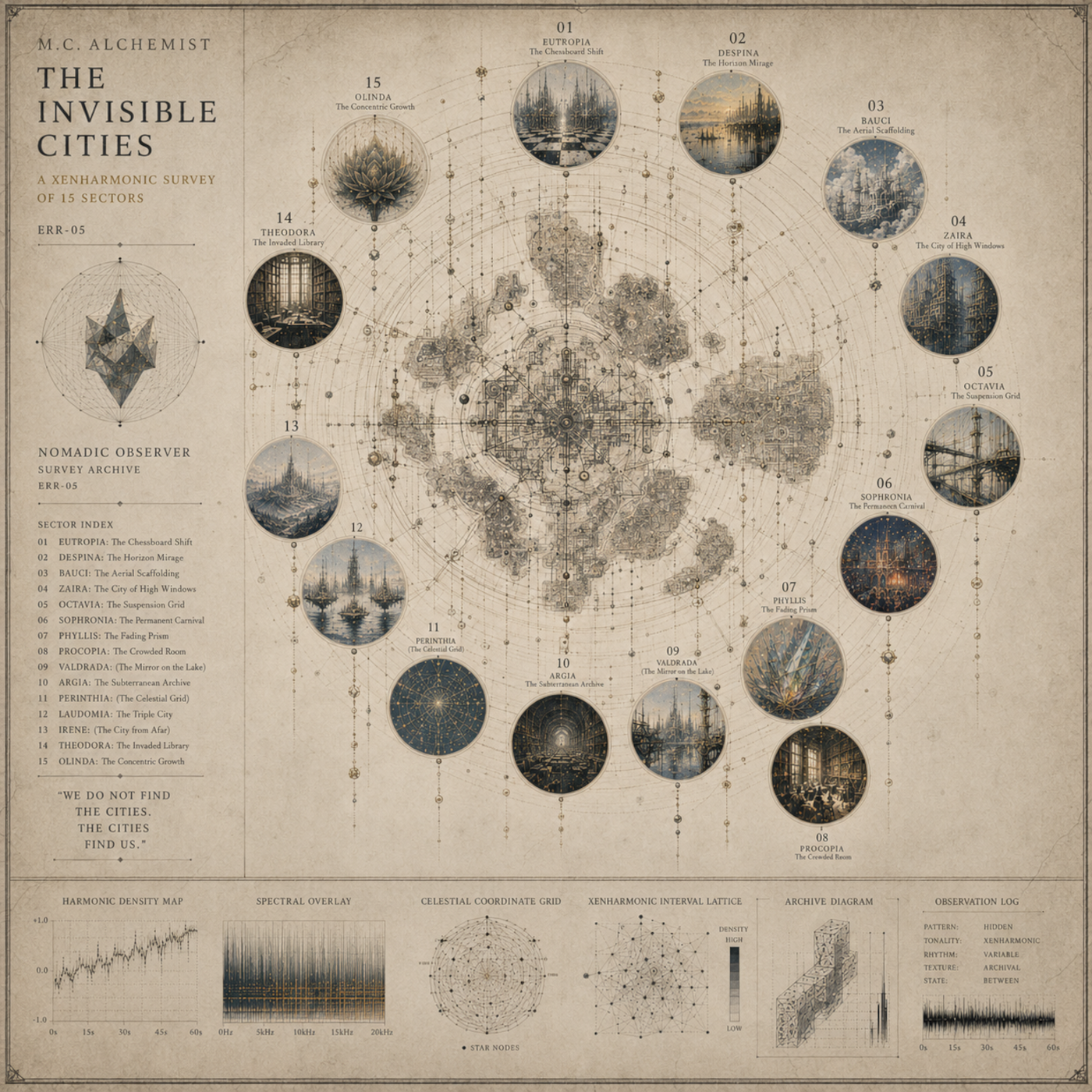
- 1. Eutropia: The Chessboard Shift
- 2. Despina: The Horizon Mirage
- 3. Bauci: The Aerial Scaffolding
- 4. Zaira: The City of High Windows
- 5. Octavia: The Suspension Grid
- 6. Sophronia: The Permanent Carnival
- 7. Phyllis: The Fading Prism
- 8. Procopia: The Crowded Room
- 9. Valdrada: (The Mirror on the Lake)
- 10. Argia: The Subterranean Archive
- 11. Perinthia (The Celestial Grid)
- 12. Laudomia: The Triple City
- 13. Irene (The City from Afar)
- 14. Theodora: The Invaded Library
- 15. Olinda: The Concentric Growth
ARCHIVE RECORD: ERR-05 // THE INVISIBLE CITIES
This archive documents the nomadic observations of the M.C. Alchemist. These fifteen sectors trace a journey through the paradoxical territories described by Marco Polo, where the architecture of the city is often a reflection of the traveler's own state of mind.
SECTOR LOGS:
Sector 01: Eutropia. A city of constant movement. When the
inhabitants grow weary of their jobs, their families, and their streets,
they move to the next identical city in the cluster to begin a new life—only
to find the same chess pieces in different squares.
Sector 02: Despina. A city that appears differently depending on
how you arrive. To the camel driver, it is a ship that will lead him away
from the desert; to the sailor, it is a camel that will lead him away
from the sea. It is a horizon made of mutual longing.
Sector 03: Bauci. A city on stilts that vanish into the clouds.
The inhabitants never set foot on the ground; they live in the sky,
obsessively observing the Earth through magnifying glasses, contemplating
the world they have abandoned.
Sector 04: Zaira. A city made of high windows and ancient gutters.
The space of the city does not contain its past; the city *is* its past.
Every stone and street corner is a recording of the events that occurred
there, etched like a groove in a record.
Sector 05: Octavia. The spider-web city. Suspended over a dizzying
void by ropes and chains, the inhabitants live in a state of high-tension
clarity, knowing their existence depends on the strength of a few
vibrating cables.
Sector 06: Sophronia. A city of two halves. One is a permanent
cluster of stone banks and prisons; the other is a temporary circus of
canvas and carousels. The inhabitants watch as the stone city is dismantled
each year while the circus remains, constant and eternal.
Sector 07: Phyllis. A city of overwhelming color and detail that
fades as you stay. The longer you walk its streets, the more the vibrant
red awnings and yellow windows disappear, replaced by the grey paths of
habit and routine.
Sector 08: Procopia. A city that grows smaller with every visit.
As the population swells, the landscape is gradually replaced by a sea of
faces. Eventually, looking out the window reveals only a wall of eyes,
unblinking and unmoving.
Sector 09: Valdrada. A city and its twin. Built on the shores of
a mirror-flat lake, every action in the city is mimicked by the reflection
below. No thought or deed is private; the two cities live in a state of
perfect, symmetrical observation.
Sector 10: Argia. The city of clay. It has earth instead of air.
The streets are filled with soil, and the houses are packed with sand.
You do not walk through Argia; you hear it through the ground—the muffled
sounds of a civilization breathing beneath the surface.
Sector 11: Perinthia. A city designed by the stars. Its walls
follow the coordinates of the planets to ensure a perfect society.
Instead, the celestial logic produced a city of beautiful mutations—a
perfect plan that resulted in a glorious, astronomical error.
Sector 12: Laudomia. The city is divided into three identical
versions of itself. The Living occupy the center, but they are constantly
peering into the mirrors of the other two: the city of the Dead, where everything
is settled, and the city of the Unborn, where everything is potential. It
is a city of overwhelming stillness, where the present moment is just a
thin membrane between two infinities.
Sector 13: Irene. Irene is a city seen from the edge of a high plateau.
You see the flickering lights, the smoke from the chimneys, and the glow of the
windows, but you never go down into it. To enter Irene is to destroy it; once you
are in the streets, it becomes a different, ordinary place. Irene exists only as
a name for that glowing cluster in the distance.
Sector 14: Theodora. The inhabitants of Theodora were so weary of the
unpredictability of nature—the pests, the flies, the beasts—that they killed them
all. They created a perfectly silent, stone-and-paper world. But in the vacuum of
that silence, the creatures from their books began to wake up. Sphinxes, griffins,
and basilisks crawled out from the margins of the manuscripts to inhabit the empty
corners of the city.
Sector 15: Olinda. Olinda is not a city that decays; it is a city that
blossoms. If you look into the very heart of the oldest, most weathered district,
you will find a miniature city budding—tiny, perfect, and vibrant. This "inner"
Olinda eventually grows, pushing the old walls outward until they become the new
outskirts. To live in Olinda is to be constantly moved toward the exterior by the
pressure of the new life growing at the center..
These recordings serve as an acoustic map of these impossible geographies, capturing the tension between the stone of the city and the air of the imagination.
// VOYAGE_COMPLETE_ERR-05
// TOTAL_SECTORS_MAPPED: 15
VOYAGE_ET_DESSIN --input="OBSERVATION" --output="IMAGINATION"
"The city does not tell its past, but contains it like the lines of a hand."