bardhonogow
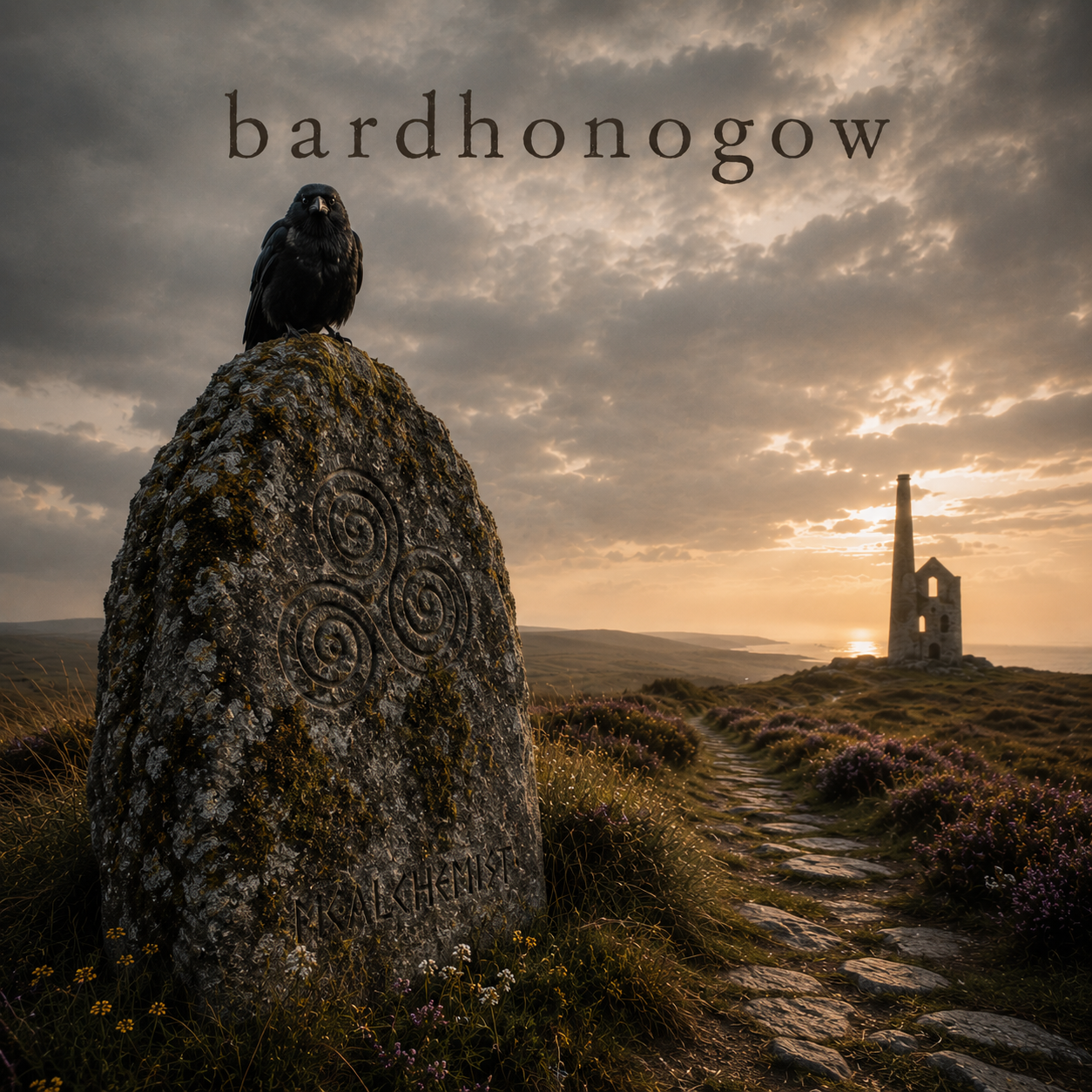
M C ALCHEMIST
- An Veyn a Borth Kov — The Stones Remember
- An Bran — The Crow
- An Fordh — The Path
- Dowr Down — Deep Water
- Ow Miras orth an Glaw — Watching the Rain
- An Gwels a Hwarthas — The Grass Laughed
- An Men a Syns an Tewlder — The Stone Holds the Darkness
- Bronn Wenneli — Brown Willy
- An Kanker — The Crab
- Dons Meyn Rosmodres — The Merry Maidens
- Un Hal Hilly-Halla
- Teudhlester an Alkemydh — The Alchemist's Crucible
- Glaw Ow Tos — Rain Is Coming
- Klog-gy-Clack
- Ny Wrug an Menydh Leverel Tra Vyth — The Hill Said Nothing
- Howl Ow Mos dhe’n Mor — The Sun Goes to the Sea
- An Myttin a Sevis war an Als — The Morning Stood on the Cliff
- Ni - We
- An Mor yn Porth Kastelboterel — The Sea in Boscastle Harbour
ARCHIVE RECORD: BARDHONOGOW
bardhonogow is a growing collection of spoken pieces shaped first for the Cornish voice. Some are poems, some are observations, and some begin with the sound of a word before deciding what they mean.
The Cornish is not treated merely as a translation of finished English text. Each piece is allowed to change while being spoken, after which the English is reshaped as a companion: close enough to guide the listener, but not intended to replace the original voice.
Across these pieces, stones, paths, crows, water, grass, rain, memory, and silence are encountered as ordinary things. Their strangeness comes mostly from being observed for slightly longer than is sensible.
FIELD NOTES:
The Stones Remember:
Sea and mist return repeatedly, leaving no lasting record of footsteps or faces.
The stones remain and, by remaining, become the keepers of everything that passes.
The Crow:
Fishermen, pilgrims, and kings come and go beneath the same watchful bird. Ask the
crow nothing. He already knows.
The Path:
Every morning the path wakes before the walkers and lies in precisely the same
place as yesterday. People follow it. It remembers none of them and continues
being a path.
Deep Water:
A light is thrown into a cold spring. The water briefly holds a face like a
postcard, but when given a name it returns only water.
Watching the Rain:
A person stands beside a stone to watch the weather. The stone proves much better
at it.
The Grass Laughed:
Marsh-grass laughs and giggles in the wind. Meaning loosens into sound: split,
share, part. The grass is cut with a tooth and grows back before the rain falls.
The Stone Holds the Darkness:
A hand holds the stone. The stone holds the darkness. Neither finds it necessary
to interrupt the silence.
Brown Willy watches the highest ground of Bodmin Moor beneath a weight of rain.
A swallow crosses the hill, small against its vastness, while the poem lingers on scale,
movement and silence.
The Crab: Kanker war an Garrek Koth celebrates the rhythm and texture of spoken Cornish.
A crab, an old rock and the sea become the building blocks of a playful tongue twister, where
meaning follows sound rather than leading it.
The Merry Maidens:
With a little poetic licence, this compact senryū works in both Kernewek and Sowsnek.
Three short lines catch the Maidens dancing in the black night upon the moor,
before the dance ends in stillness and stone has the final word.
Un Hal Hilly-Halla:
A Cornish nonsense poem of whistling wind, laughing grass, a grazing cow, an increasingly
excitable frog, and a stone that contributes only tok. Sound leads meaning throughout,
before the whole strange little moor settles down with a final Nos da.
The Alchemist’s Crucible:
A bilingual alchemical incantation of hidden fire, silver scales, lead and gold.
Warm, mystical accompaniment carries the transformation from common ash to something
half-divine, before the night is clothed in golden wings.
Glaw Ow Tos — Rain Is Coming:
Cornwall has gone without rain for weeks, but nobody quite trusts the clear sky.
The gull knows, the sheep know, and Cornwall says nothing, while somewhere beyond
the sea the rain remembers the way home.
Klog-gy-Clack:
A Cornish nonsense rhyme of crashing sea, calling chough, a clinking bocka in a cave,
and a crag whose entire vocabulary appears to be boom. Sound and meaning tumble
together until morning arrives and each voice gives one last, quieter reply.
The Hill Said Nothing:
Among Bronze Age hut circles, the speaker asks the hill what it remembers of the people
who once lived there. The stones remain, the wind moves through the grass, and four
thousand years of questions receive no answer at all.
Howl Ow Mos dhe’n Mor — The Sun Goes to the Sea:
A quiet bilingual haiku of sunset over the Cornish shore: the sun slipping seaward,
long shadows stretching across the sand, and fiery clouds burning above.
An Myttin a Sevis war an Als — The Morning Stood on the Cliff:
A quiet bilingual haiku of dawn on the Cornish coast: night fading,
morning standing upon the cliff, and first sunlight waking the sea.
Ni — We:
A bilingual folkloric invocation in which piskies, spriggans, bockas, knockers and the
other hidden folk speak as one. Dual voices, whispered rhythms and rising chant turn the
poem into something closer to ritual performance than simple recitation.
An Mor yn Porth Kastelboterel — The Sea in Boscastle Harbour:
A Kernewek-led Petrarchan sonnet shaped around Boscastle harbour, where the tide enters
between stone walls only to reveal that the harbour never truly holds the sea. The Cornish
follows an ABBA ABBA CDE CDE rhyme scheme; the English is a companion translation,
allowed to follow the meaning without being forced into the same formal pattern.
WORDS SPOKEN, WORDS LISTENED TO
The pieces are written for performance rather than silent accuracy alone.
Pauses, repetition, breath, consonants, and vowel sounds carry part of the meaning.
The English text therefore serves as a nearby path, not a fence around the Cornish.
This is not intended as a formal language lesson. It is an experiment in allowing
Kernewek to lead the rhythm, humour, and atmosphere of a contemporary spoken-word
collection.
A note on the voices:
The spoken voices on bardhonogow are AI-generated. Quite simply, I hate the sound
of my own recorded voice, and the stones showed no interest in doing the narration.
The words, translations, pronunciation direction and performances are shaped and
directed by M C ALCHEMIST; the synthetic voice is simply another part of the production.
The record remains open. Further pieces may be added as they arrive.
// RECORD REMAINS OPEN
AN MEN, AN FORDH, HAG AN TAW
The stone, the path, and the silence.
Sustain the Archive