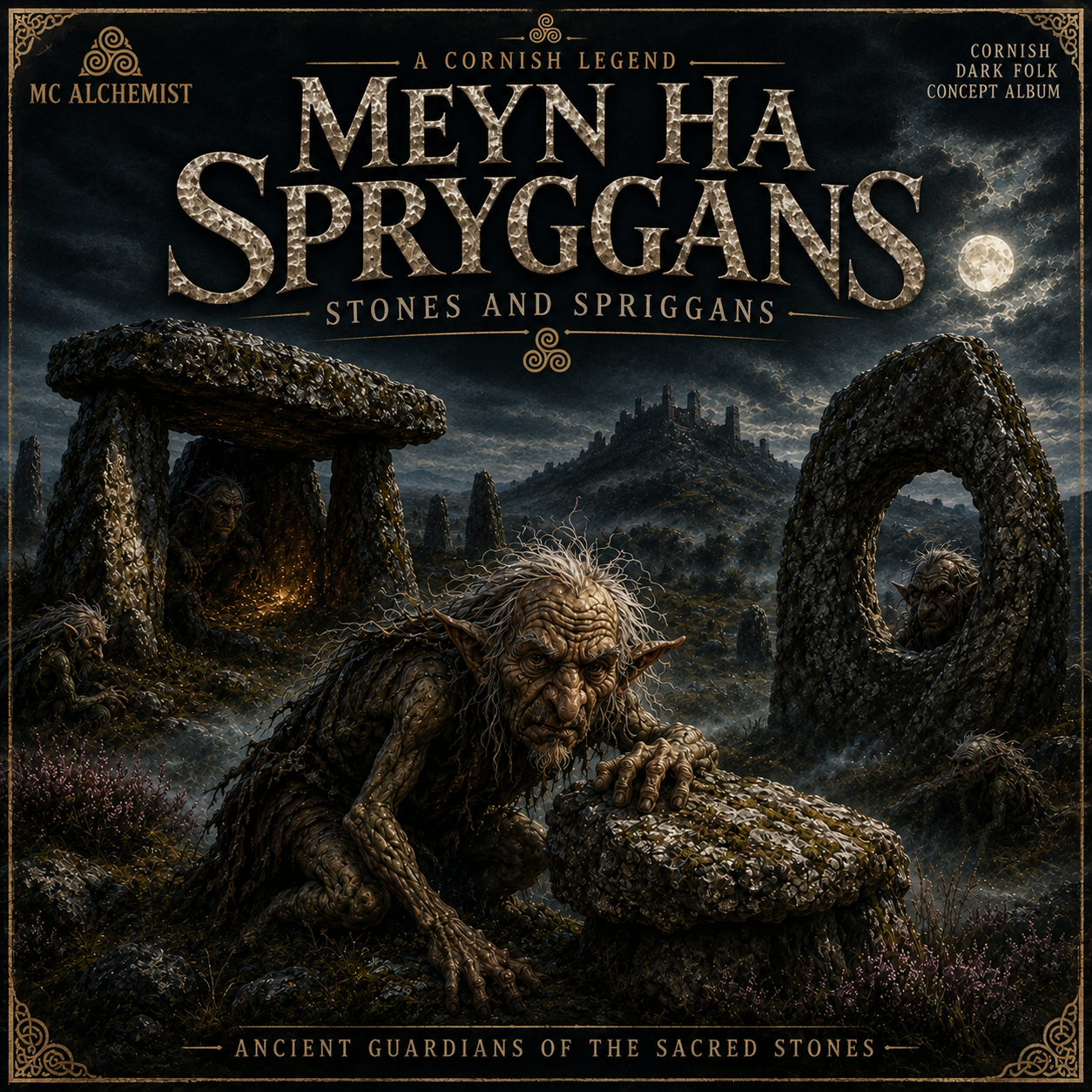
MEYN HA SPRYGGANS
ANCIENT GUARDIANS OF THE SACRED STONES
M C ALCHEMIST
- Ni yw an Spryggans (We Are the Spriggans)
- Gwithya an Tresor (Guarding the Treasure)
- Korfow a-gans Kevri (Bodies of Giants)
- Spryggans ow Tevi (Spriggans Swelling)
- Hager-Awel an Carn (Storm of the Carn)
- Sowpig ha Spryggan (Woodlouse and Spriggan)
- Gwithya an Mên-An-Tol (Guarding the Holed Stone)
- An Spryggan ow Hwerthin (The Laughing Spriggan)
- Dewen an Garrek (The Two on the Rock)
- Tewelder an Spryggan (Darkness of the Spriggan)
ARCHIVE RECORD: MEYN HA SPRYGGANS // STONES AND SPRIGGANS
Meyn ha Spryggans is a ten-part Cornish folklore cycle devoted entirely to the spriggans: ancient, wrinkled guardians whose presence clings to quoits, barrows, standing stones, abandoned workings, and the hidden places beneath the moor.
These are not presented as harmless little goblins. In the older imaginative landscape they are territorial custodians, protectors of mineral wealth and sacred ground, and lingering spirits of the giants who once crossed Cornwall. Small and easily overlooked by day, they may swell into monstrous forms when angered.
The album moves through granite chambers, exposed mineral lodes, storm-bound tors, insect worlds beneath stones, lost night paths, and the watch kept around Mên-an-Tol. Its recurring warning is simple: the land is older than the trespasser, and not everything buried beneath it is waiting to be claimed.
FIELD NOTES:
Ni yw an Spryggans:
The guardians introduce themselves from beneath the flat stones. Old, wrinkled,
and small among the gorse by day, they belong to the night, the cairn, and the
sacred ground that remembers their ancient hands.
Gwithya an Tresor:
The treasure is not a theatrical heap of minted coins, but the wealth held within
the earth itself: mineral veins, ore, metal, and the glittering lodes beneath granite.
The spriggans guard the shaft and deny the thief any claim upon the mountain’s bones.
Korfow a-gans Kevri:
The diminished spriggan and the ancient giant are revealed as two states of one
being. Stone bodies stir beneath the moor, and the small guardian carries within it
the memory—and possible return—of the old giants.
Spryggans ow Tevi:
Anger breaks the limits of the small body. The spriggans swell above stone and
gorse until the wizened dwarf becomes a towering giant once more, ancient power
expanding into the night.
Hager-Awel an Carn:
The carn itself is swallowed by a sudden local storm. Wind, rain, darkness, and
the tolling bronze bell become the spriggans’ warning, turning the familiar path
into a trackless and hostile moor.
Sowpig ha Spryggan:
The scale contracts beneath a lifted slab. Woodlice, ants, roots, damp soil, and
tiny spriggans share the hidden world beneath ordinary footsteps. The folklore is
not only upon the tor; it moves in the minute life beneath the stone.
Gwithya an Mên-An-Tol:
At the holed stone the guardians keep watch through the ancient opening. The act
of crawling through becomes an approach to a threshold, watched by beings who do
not regard curiosity as permission.
An Spryggan ow Hwerthin:
A traveller loses both road and track while dry laughter moves between stone and
earth. The spriggan remains only partly seen; its mockery is more certain than its
shape, and the moor closes around the chosen night.
Dewen an Garrek:
Two spriggans keep separate watches from distant tors, male and female voices calling
across the darkness. Stone answers stone; the paired guardians protect the buried
wealth and warn that the thief may yet return.
Tewelder an Spryggan:
The album gathers its images into a final darkness: treasure, lost paths, laughter,
storm, stone, and Mên-an-Tol. Choirs, bell, and grinding granite recede until the
earth itself falls silent.
ANCIENT GUARDIANS OF THE SACRED STONES
Spriggans occupy an uncertain border between creature, spirit, ancestor, and place.
They are associated with prehistoric monuments, buried treasure, remote moorland,
and the remnants of the ancient giants. Their small and grotesque form should not
be mistaken for weakness: when threatened or angered, tradition allows them to
expand into the gigantic shapes from which they may have descended.
Within this album, “treasure” is treated primarily as the hidden wealth of the
Cornish earth—ore, mineral lodes, and precious metal held inside the stone—rather
than as a chest of finished trinkets. The spriggans are therefore not collectors.
They are custodians.
The recurring warnings against theft and trespass are not simply threats made by
monsters. They express an older relationship with landscape: stones may be sacred,
paths may belong to powers other than the walker, and the riches beneath the ground
carry obligations as well as value.
The ten movements do not tell the life of one spriggan. Together they form a
field-guide in sound: an encounter with the traits, habitats, voices, transformations,
and terrors by which the old guardians might still be recognised.
The stones do not sleep.
They keep watch.
// END OF RECORD
AN MEYN, AN SPYRYSOW, HAG AN TEWELDER
The stones, the spirits, and the darkness.
Sustain the Archive