AN FORDH KELLES
THE JOURNEY OF A NIGHT'S WALK
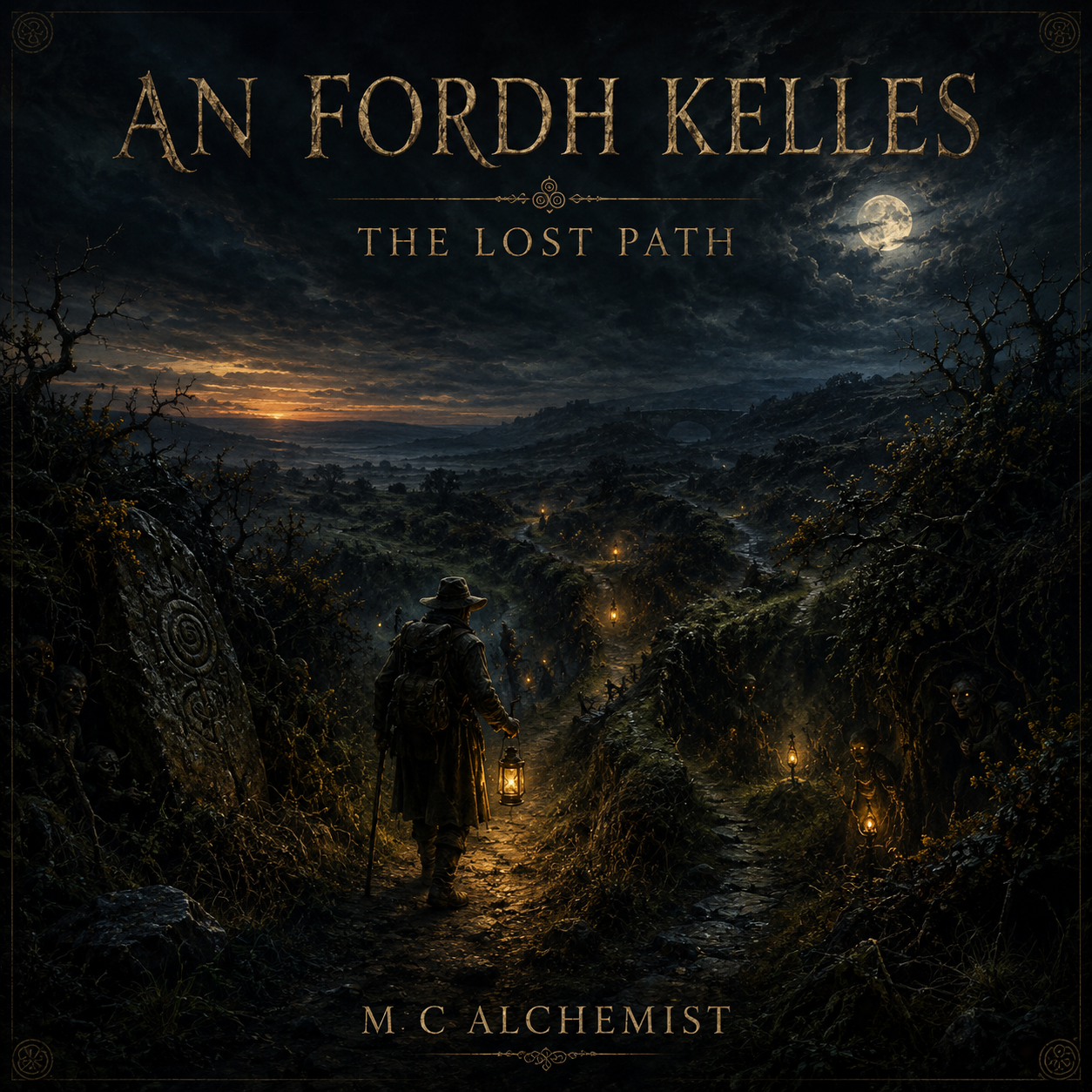
M C ALCHEMIST
- Golowgell (Dusk / The Yellow Light)
- Lloer ha Llowen (Moonlight and Mirth)
- Pyskis ow Gnaffya (Piskies Borrowing)
- Golow an Pyskis (The Piskie Lights)
- An Fordh Kelles (The Lost Path)
- Pons Heb Dowr (Bridge Without Water)
- Dans an Kell (Dance of the Lost)
- Koslowi orth an Gwyns (Listening to the Wind)
- Yn-dann an Spern (Under the Hawthorn)
- Myttin ha Mur (Morning and Much)
ARCHIVE RECORD: AN FORDH KELLES // THE LOST PATH
An Fordh Kelles is a ten-part Cornish folklore cycle shaped as one continuous night walk. A traveller leaves the village in the last yellow light and is drawn, by small degrees, into a landscape where familiar lanes, bridges, hedges, and distances cease to behave as they should.
The piskies rarely confront the traveller directly. Their power works through invitation, distraction, and alteration: laughter beneath leaves, a watch that stops, keys heard where no hand can reach them, and lights that retreat whenever they are approached. The ordinary world is not destroyed. It is quietly rearranged.
The album passes from dusk into moonlight, petty borrowing, false illumination, the loss of the path, an impossible bridge, a dance outside ordinary time, the sudden emptiness of the wind, sleep beneath an ancient hawthorn, and a morning whose apparent calm cannot restore what the night has taken.
FIELD NOTES:
Golowgell:
The traveller leaves the safety of the village as the last yellow light gathers
along hedge, thorn, and silent crossroads. The first invitation sounds gentle;
home becomes distant before the journey appears to have truly begun.
Lloer ha Llowen:
Moonlight settles over the lane while laughter moves through the trees. Nothing
yet sounds openly threatening. The mirth works as an invitation, drawing the
traveller a little farther from the path and a little nearer to the unseen company.
Pyskis ow Gnaffya:
The piskies announce themselves through petty theft rather than violence. A walking
staff disappears, keys jingle from beyond reach, pockets empty, and the watch falls
silent. Before fairy time begins, ordinary time has already lost its witness.
Golow an Pyskis:
A lantern-like glow appears ahead and retreats whenever it is followed. What seems
to promise another traveller, a house, or a safe route instead leads deeper into
wet ground, reeds, mist, and the piskies' shifting field of lights.
An Fordh Kelles:
The trick succeeds. On turning back, the traveller finds that the route already
walked no longer exists in any usable form. Hedges close into briar, crossroads
multiply, and “back” becomes a remembered idea without a corresponding lane.
Pons Heb Dowr:
A familiar stone bridge stands where expected, but the river beneath it has vanished.
The hollow gap and the path beyond refuse ordinary geography. Recognition remains,
yet the landmark no longer confirms where the traveller is.
Dans an Kell:
The traveller is caught within a bright, spinning dance upon the dew-soaked grass.
Music, laughter, and movement erase fatigue and judgement. Seconds may contain
hours—or years—while the ring turns beyond the measurement of the stopped watch.
Koslowi orth an Gwyns:
The dance ends without warning. The dancers, music, and lights vanish, leaving the
traveller alone inside the ring. Only wind remains, carrying fragments that might
be voices, memory, or the last echo of a company that was never fully seen.
Yn-dann an Spern:
Exhaustion becomes enchantment beneath the ancient hawthorn. The tree offers shelter,
but also a final threshold. The traveller lies down in damp grass while the piskies'
whispers soften into a lullaby and the night closes over memory.
Myttin ha Mur:
Morning restores light but not certainty. The traveller wakes cold beneath the
hawthorn, the watch still useless and the night largely erased. Home may be nearby,
or much more than one night may have passed. Dawn refuses to settle the account.
THE JOURNEY OF A NIGHT'S WALK
Piskie stories often begin not with a dramatic apparition, but with a small failure
of orientation.
A known lane bends wrongly. A light appears where no house stands. A possession is
mislaid and then heard somewhere impossible. Laughter moves across the hedge without
revealing a speaker. Each disturbance is minor enough to dismiss, yet together they
remove the traveller's dependable relationship with the landscape.
Within this album, being piskie-led is not simply the act of becoming geographically
lost. The traveller loses the system by which place can be understood. A bridge may
remain recognisable while ceasing to cross water. A path may lie close to home while
providing no route towards it. A few steps may consume a night, or a night may conceal
a far greater interval.
The piskies do not need to overpower the traveller. Curiosity, pursuit, tiredness, and
the wish to make sense of each new disturbance carry the journey onward. Their mischief
is therefore intimate: the victim participates in the enchantment by repeatedly taking
one more apparently reasonable step.
The hawthorn marks the final surrender of ordinary measurement. Sleep removes the last
witness, and morning arrives without proof of what occurred beneath the moon. The key
may return. The path may reappear. The village may be close.
But the stopped watch keeps no account.
And neither do the piskies.
// END OF RECORD
AN FORDH, AN GOLOW, HAG AN TEWOLDER
The path, the light, and the darkness.
Sustain the Archive