Re: Jupiter
Here's a video animation of the motion of Jupiter and moons between my two images. Note the apparent back and forth motion against the background stars, known as [i]Prograde[/i] (or Direct) [Regular average yearly motion of planet through the stars = movement west to east ] and [i]Retrograde[/i] [Reversed motion through the stars relative to average yearly motion = movement east to west]
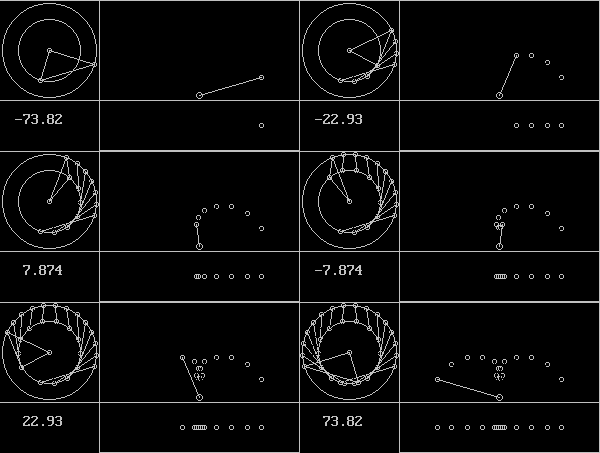
[b]Helocentric View from the North Ecliptic Pole [/b][upper left]
This views shows the motion of the Earth and a planet relative to the Sun - Both move anti-clockwize as seen from the north. The Earth moves on the inner orbit. This animation draws a line from the sun to the planet to show the helocentric longitude p lus the line of sight to the planet from the Earth. Only the line of sight remains with circles to show the former positions as the animation proceeds.
[b]Geocentric view from the North[/b] [upper right]
This view show the relative angle of view and the relatitve distance to the planet keeping the Earth fixed.
[b]Motion of the Planet in the sky as seen from the Earth[/b] [lower right]
This view show the projection of the image of the planet motion on the sky and illustrates the retrograde motion near opposition
[b]Position angle[/b] [number to lower left]
The angle of the planet from opposition (negative angle is to the west of opposition) When this angle is zero the planet is at oppostion (with the Sun).
Image & text from http://www.go.ednet.ns.ca/~larry/ Created by L.Bogan - Mar 1998
Seems I was lucky enough to get my BRT images either side of Sept 8 2008, when Jupiter changed from its 4 month period of Retrograde motion to Prograde motion, which will now last for another 13 months or so. Now that its retrograde motion is ended, Jupiter will seem to move closer to the setting sun each evening. It will be visible for a few more months, but now is the best time to observe it because currently it is roughly opposite the sun in Earth’s sky.
Link >> Jupiter motion video
[size=9]Reload the page to see the animation again[/size]
[b]Helocentric View from the North Ecliptic Pole [/b][upper left]
This views shows the motion of the Earth and a planet relative to the Sun - Both move anti-clockwize as seen from the north. The Earth moves on the inner orbit. This animation draws a line from the sun to the planet to show the helocentric longitude p lus the line of sight to the planet from the Earth. Only the line of sight remains with circles to show the former positions as the animation proceeds.
[b]Geocentric view from the North[/b] [upper right]
This view show the relative angle of view and the relatitve distance to the planet keeping the Earth fixed.
[b]Motion of the Planet in the sky as seen from the Earth[/b] [lower right]
This view show the projection of the image of the planet motion on the sky and illustrates the retrograde motion near opposition
[b]Position angle[/b] [number to lower left]
The angle of the planet from opposition (negative angle is to the west of opposition) When this angle is zero the planet is at oppostion (with the Sun).
Image & text from http://www.go.ednet.ns.ca/~larry/ Created by L.Bogan - Mar 1998
Seems I was lucky enough to get my BRT images either side of Sept 8 2008, when Jupiter changed from its 4 month period of Retrograde motion to Prograde motion, which will now last for another 13 months or so. Now that its retrograde motion is ended, Jupiter will seem to move closer to the setting sun each evening. It will be visible for a few more months, but now is the best time to observe it because currently it is roughly opposite the sun in Earth’s sky.