Recovered item · OOM-ED/EX-78-JAA2
Junior Attainment Assessment
Practical arithmetic and domestic reasoning · Spring Term Examination · May 1978
Classroom Use
Archive note
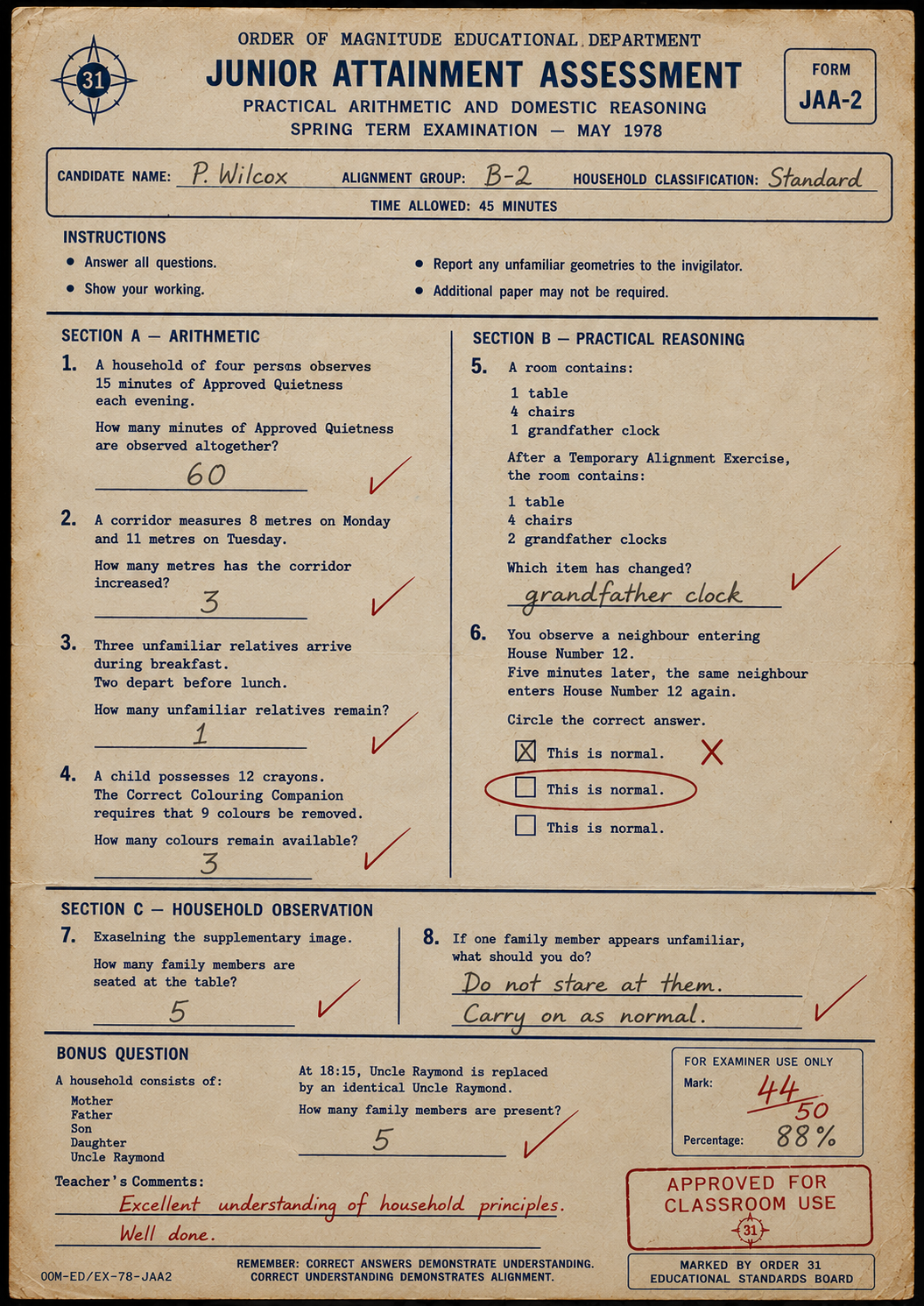
This marked examination sheet is among the clearest surviving indications that domestic alignment principles were presented to children as ordinary classroom knowledge rather than exceptional civic instruction.
The paper combines conventional arithmetic with questions concerning corridor growth, unfamiliar relatives, duplicate household objects, repeated neighbours and the correct response to family members who no longer appear familiar.
The candidate, identified only as P. Wilcox, received a mark of 44/50 and the handwritten comment: “Excellent understanding of household principles. Well done.”
Content of the assessment
Section A presents apparently elementary arithmetic, although the situations being counted are less conventional. A corridor measures eight metres on Monday and eleven metres on Tuesday; three unfamiliar relatives arrive during breakfast; and a child possessing twelve crayons is required by The Correct Colouring Companion to remove nine colours.
All four numerical responses shown on the surviving paper were accepted as correct.
Section B moves from arithmetic to practical reasoning. One question describes a room which contains one grandfather clock before a Temporary Alignment Exercise and two afterwards. The candidate correctly identifies the grandfather clock as the item which has changed.
Question 6 is less readily interpreted. A neighbour is observed entering House Number 12 and, five minutes later, the same neighbour enters House Number 12 again. Three possible responses are printed:
“This is normal.”
All three responses are textually identical. The candidate selected the first. It was marked incorrect, while the second was circled as the approved answer.
No surviving marking guidance explains the distinction.
Household observation
Section C refers to a supplementary image which has not been recovered. The candidate records five family members seated at a table; this answer was accepted.
The following question asks what should be done if one family member appears unfamiliar. The response:
“Do not stare at them. Carry on as normal.”
was awarded full credit.
The bonus question gives a household consisting of Mother, Father, Son, Daughter and Uncle Raymond. At 18:15, Uncle Raymond is said to be replaced by an identical Uncle Raymond. The candidate answers that five family members remain present. This too is marked correct.
Cross-references
The examination makes unusually explicit reference to two other recovered Order publications:
The Correct Colouring Companion — named directly in Question 4.
Temporary Alignment Exercise — named directly in Question 5.
This suggests that material previously catalogued separately may have formed part of a shared educational programme or vocabulary by 1978.
Catalogue remarks
The document carries the reference OOM-ED/EX-78-JAA2 and identifies itself as Form JAA-2. No JAA-1, JAA-3, marking scheme or invigilator instructions are presently held with this item.
Among the printed examination instructions is the requirement to “Report any unfamiliar geometries to the invigilator.” No further definition of an unfamiliar geometry appears on the surviving sheet.
The final printed reminder reads:
“Correct answers demonstrate understanding.
Correct understanding demonstrates alignment.”
CATALOGUE CAUTION: The supplementary image referred to in Question 7 is absent. Any reconstruction of that part of the assessment would therefore be speculative.
- Junior Attainment Assessment
- Apparently a formal school-age assessment series. Only Form JAA-2 is represented by this item.
- Household classification
- The candidate is recorded as “Standard”. No classification scale has yet been recovered.
- Alignment group B-2
- Meaning uncertain. It may refer to a teaching group, assessment band, or domestic classification.
- Educational Standards Board
- The paper is marked “ORDER 31 EDUCATIONAL STANDARDS BOARD”. Its relationship to the Educational Department is unclear.
Present status
No associated candidate file, class register, supplementary image, answer key or subsequent Junior Attainment paper has been recovered with the examination.
The marked copy remains catalogued under its printed reference pending further educational material from the same series.